

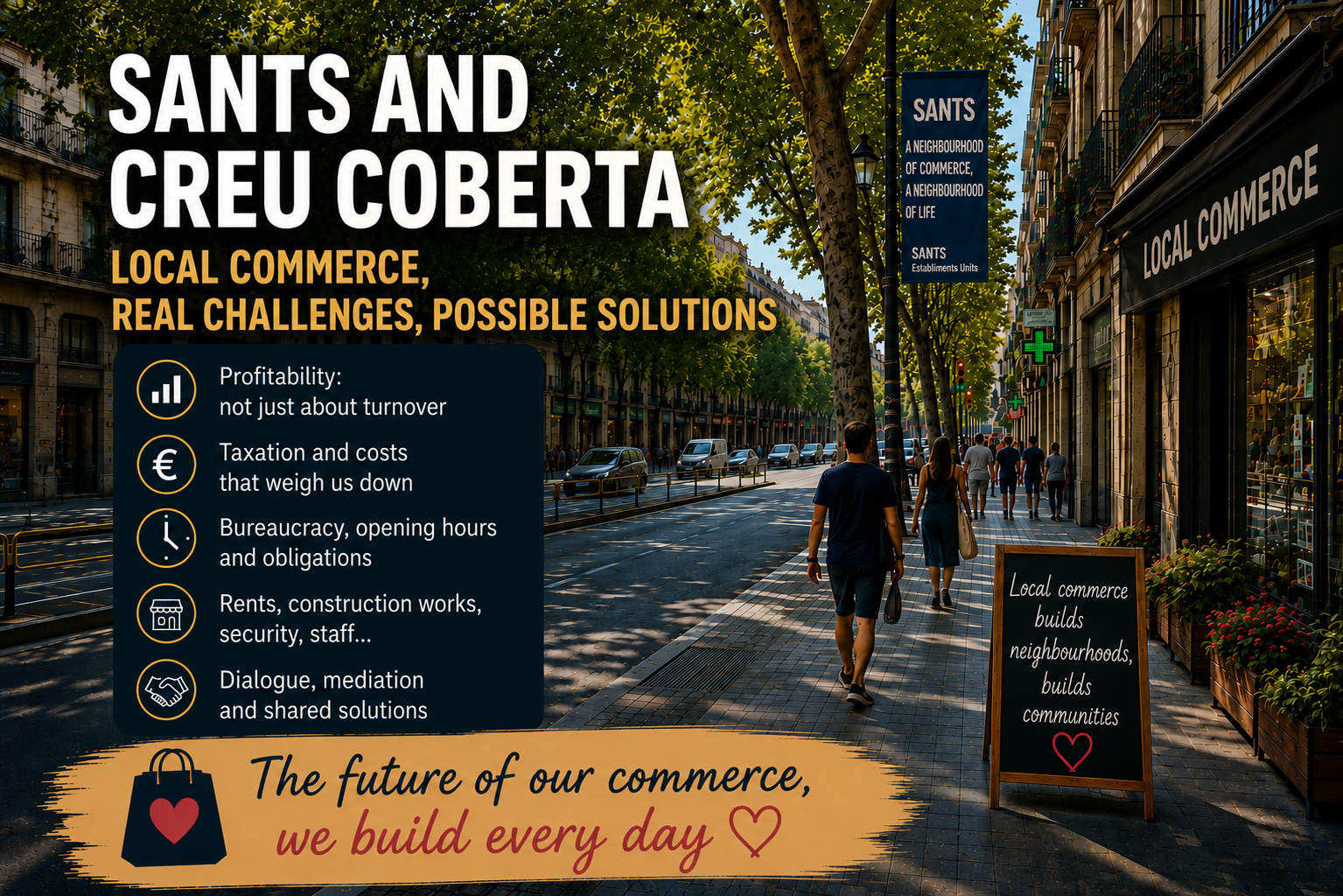
26 Aug What Is Happening to Retail in Sants and Creu Coberta?
What Is Happening to Retail in Sants and Creu Coberta? Profitability, Taxation and the Future of Local Commerce
This article is dedicated to my fellow members of Sants Establiments Units and to the retailers and business owners of Creu Coberta, with whom we share one of Barcelona’s major shopping areas, as well as many of the challenges currently facing local commerce.

Last Monday, 24 August, 3Cat’s Telenotícies devoted a report to the changing face of traditional retail along Carrer de Sants and Creu Coberta. The disappearance of long-established businesses, the arrival of new types of shops and the gradual transformation of one of Barcelona’s major commercial areas are realities that anyone familiar with the neighbourhood can see simply by walking through its streets.
Watch the 3Cat report on retail in Sants and Creu Coberta
The report points in particular to two reasons for this transformation: the cost of commercial rents and the lack of generational succession. These are two factors that certainly exist and that it would be absurd to deny. However, after watching the report and, above all, speaking to retailers and business owners in Sants over the past few days, I believe the reality is considerably more complex.
There is one word that, in my view, should occupy a central place in this debate: profitability.
A business does not live on turnover
This is perhaps the first point we should make clear.
A business does not live on what it bills. It lives on what is left after everything has been paid.
Staff, social security contributions, rent where applicable, utilities, insurance, accounting and administrative services, maintenance, IT systems, commissions, taxes, fees and many other expenses gradually reduce a business’s margin.
That is why I believe that focusing the debate mainly on commercial rents may lead us to an incomplete diagnosis. Of course rent matters. Premises with a disproportionate rent can make any business unviable. But rent is only one of the many factors that determine whether a business works.
Monthly rent of €1,500, €1,700 or €2,000 may be affordable for one type of business and completely unviable for another. It will depend on turnover, commercial margins, staffing requirements, investment, utilities and all the other costs involved.
Therefore, rather than simply asking whether rents are expensive, perhaps we should be asking why it is becoming increasingly difficult for certain businesses to afford those rents while remaining profitable.
Perhaps the lack of generational succession is a consequence
There is also much discussion about the lack of generational succession. It is true that many shopkeepers and business owners reach retirement age and their sons and daughters decide to pursue other careers.
But I would turn the question around: why do they not want to continue?
When a young person sees that taking over the family business means working long hours, risking capital, managing staff, dealing with taxes and social security contributions, continually adapting to new administrative requirements and ultimately achieving only limited profitability, perhaps the problem is not a lack of vocation or an unwillingness among younger generations to work.
Perhaps the business they are being offered the opportunity to continue is simply no longer financially attractive enough.
For this reason, I believe that, at least in many cases, the lack of generational succession is not so much the cause of the problem as one of its consequences.
If a business works, has customers, offers prospects for the future and enables someone to make a decent living, it will be much easier to find people willing to continue it.
The cost of hiring also affects growth
Another issue has repeatedly emerged in my conversations with retailers and business owners over the past few days: the cost of employing staff.
One example I was given seems particularly significant. A retailer needs to hire one additional employee in order to run the business under better conditions. According to his calculations, this would cost approximately €2,100 per month in salary and social security contributions.
I am not presenting this figure as a general cost of hiring, because it will obviously depend on salary, working hours, the applicable collective agreement and many other variables. What interests me is the underlying problem.
The business needs to grow in order to operate better, but the cost of growing may prevent it from doing so.
This has consequences. The business owner continues to work more hours personally than would be desirable, cannot extend opening hours or services, gives up business opportunities and ultimately risks becoming exhausted.
This reality also helps explain why starting a business, expanding an existing one or hiring staff is now perceived as a decision involving considerable risk.
Selling more does not necessarily mean earning more
Another business owner told me that he has considered moving his business to Carrer de Sants on several occasions.
He is convinced that a location with greater footfall would probably enable him to increase sales. But relocating would mean paying between €1,700 and €2,000 per month in rent for premises of approximately 75 to 100 square metres, hiring two additional employees and also meeting the initial investment required to refurbish and adapt the premises.
The result is that, although he considers Carrer de Sants commercially attractive, he does not believe taking on that level of risk is viable.
This experience highlights an idea that I consider fundamental:
Higher turnover does not necessarily mean higher profits.
A business can attract more customers and increase sales, yet still become less profitable if doing so requires more staff, a larger cost structure, more expensive premises and a substantial initial investment.
This brings us to one of the paradoxes we should consider when we see vacant premises on a major shopping street: there may be business owners who would like to occupy them and expand their businesses, but who consider the overall risk they would have to assume excessive.
Taxation and bureaucracy: what is left at the end?
Personally, I believe that the tax burden and the overall economic costs borne by small businesses are excessive.
And I am not referring specifically to Barcelona City Council. I am referring to public administrations as a whole.
If we genuinely want to support small local businesses, we cannot simply look at how much they turn over. We should look at how much remains after paying taxes, social security contributions, staff and all other expenses, as well as how many hours the business owner has had to work to achieve that result.
There is also another cost that is often more difficult to quantify: the time devoted to bureaucracy.
Taxation, invoicing, consumer regulations, data protection, employment legislation, safety, waste management, opening hours, inspections and other obligations may each have their own justification. The problem for a small business is their cumulative effect.
A large company has legal, tax, employment, administrative and IT departments. In a small shop, it is often the same person who opens the premises, buys stock, sells, serves customers, speaks to suppliers, deals with day-to-day problems and, once the working day is over, still has to deal with administrative matters.
These are working hours, but they are hours for which nobody pays.
VERI*FACTU is a recent example of the need to adapt to regulatory changes in invoicing. I am not questioning the purpose of the measure. My point is that every new obligation means finding out what is required, consulting advisers, adapting software and procedures, and devoting time and resources to implementation.
All of this also forms part of the real profitability of a business.
We also need to talk about customers’ purchasing power
So far, we have mainly discussed the costs borne by retailers and business owners, but there is another side to the same issue: their customers’ purchasing power.
If a household has to devote an increasingly large proportion of its income to housing, food, energy and other basic necessities, it has less disposable income available for other purchases.
And when price becomes the main purchasing criterion, certain large digital platforms have a considerable advantage over small physical retailers.
This does not mean that the Internet is necessarily the enemy of local commerce. Quite the opposite. Digitalisation also offers enormous opportunities to communicate, sell, build customer loyalty, manage stock more efficiently and reach new audiences.
The challenge is to ensure that small local businesses can take advantage of technology without losing what sets them apart: proximity, product knowledge, service, trust and their connection with the neighbourhood.
Rents matter, but they do not explain everything
Of course we need to talk about commercial rents. But I find it difficult to accept that they are the main explanation for what is happening.
Some retailers remember periods when rents also represented a considerable financial burden and yet it was difficult to find vacant commercial premises along Carrer de Sants and Creu Coberta.
The difference is that physical retail had a different capacity to generate business.
That is why I believe that, before suggesting that the solution lies primarily in intervening in commercial rents, we should analyse the overall economic viability of the businesses we want to occupy those premises.
The question is not simply how much the premises cost. It is how much that business needs to sell in order to pay for the premises, staff, taxes, social security contributions, utilities and all other expenses and, after all that, provide a reasonable return to the person who has invested their money and devotes their working life to the business.
Opening hours, security, inspections, construction works… it all adds up
The everyday reality of a small retailer involves many other factors.
There are opening hours. There is staff management. There are inspections and administrative obligations. There is security.
For a retailer, suffering a theft is not simply a statistic. It is a financial loss, but it also means police reports, insurance claims, security systems, time spent dealing with the consequences and the need to remain constantly alert to what is happening both inside and outside the premises.
In the specific case of Sants, we must also consider the disruption caused by the Metro works. These works are necessary and obviously have to be carried out. But that does not prevent us from recognising that changes to mobility, barriers, noise and difficulties of access can place additional pressure on affected businesses.
The point is not that the works should not be carried out. The point is that we must also consider the people who need to keep opening their businesses every morning while the works continue.
Small local businesses are part of the economy, but they are also part of the neighbourhood
A hardware shop, bakery, haberdashery, bookshop, clothing store, bar or any other local establishment is, first and foremost, a business. And if it is to continue to exist, it must be profitable.
But local commerce also means lights on in our streets, people coming and going, relationships between neighbours, knowledge of the local community, security, diversity and life.
This does not mean that every traditional business should last forever. Nor does it mean that new businesses are worse than old ones. Sants has always changed and will continue to do so.
What concerns me is that we may come to regard it as normal for running a small business simply not to be worthwhile.
Because if that happens, no institutional campaign and no appeal for generational succession will solve the problem.
What can we do?
I do not believe there is a single solution. Precisely because there is no single cause.
But I do believe we should seriously discuss proportionate taxation, administrative simplification, affordable employment costs, useful support for digitalisation, security, accessibility to shopping areas and measures that enable businesses to remain viable and grow.
And before deciding what local commerce needs, we should do something very simple: listen to business owners.
Ask the people who open their businesses every morning what prevents them from hiring another employee, expanding, investing, moving to better premises or ensuring continuity for the family business.
Because we will probably hear answers that are quite different from those we obtain when the debate is approached exclusively from the outside.
Commerce, consumer issues and business disputes: we also need dialogue
There is another perspective from which I view this reality: my work as a lawyer, mediator and conciliator.
Behind businesses there are also disputes. Disputes between business partners, problems within family businesses, disagreements between landlords and tenants, employment disputes, disagreements with suppliers, consumer claims, difficulties arising from generational succession or situations in which a company needs to reorganise because the model that worked for many years no longer produces the same results.
Business mediation, conciliation, consumer mediation and Alternative Dispute Resolution methods (MASC) can help resolve many of these conflicts without adding further costs, time and strain to businesses that are already under considerable pressure.
This approach to resolving disputes can also be useful when we talk about the future of local commerce.
Public authorities, business owners, property owners, employees, trade associations, consumers and local residents do not always have the same interests. But that does not mean those interests are incompatible.
Listening, understanding each party’s interests and seeking solutions that allow economic activity to remain in our streets is also a way of supporting local commerce.
What do we want Sants to look like ten years from now?
As a member of the Board of Sants Establiments Units and as someone who has been closely connected to Sants for many years, I felt that the Telenotícies report provided a good opportunity to put this debate back on the table.
Let us talk about rents. Let us talk about generational succession. Let us talk about the Internet, new consumers and new business models.
But let us also talk openly about profitability, taxation, social security contributions, bureaucracy, regulation, opening hours, labour costs, purchasing power, security and the real conditions under which someone today decides to open and maintain a small business.
Perhaps the question is not simply why the sons and daughters of a retailer do not want to continue the family business.
The question we should be asking ourselves is:
What conditions are we creating to make it worthwhile for them to continue?
If a small business is viable, has customers and provides a decent return, it will be much easier to find people willing to invest in it, take on a commercial lease, employ staff, modernise the business and, when the time comes, ensure its continuity.
Retail in Sants and Creu Coberta will change. Certainly. It always has.
But changing is one thing. Ceasing to be viable is another.
The challenge is to ensure that commerce remains commerce, that it remains diverse, that it continues to generate economic activity and employment, and that it continues to bring life to our streets.
Daniel Sererols Villalón
Lawyer, Mediator and Conciliator
Board Member of Sants Establiments Units
Business Lecturer at La Salle Gràcia
Member of the Consell de Ciutat de Barcelona
Board Member of Federació Veïns
President of the Associació de Veïns i Veïnes de la Plaça de la Farga
📞 661 463 306
✉️ daniel@mediadorconflictos.com