
20 Jun What About the Rights of Grandsons and Granddaughters?
What About the Rights of Grandsons and Granddaughters?
The Right of Children to Maintain Relationships with Their Grandparents and Other Family Members
A Question I Hear More and More Often as a Family Mediator in Barcelona
As a family mediator in Barcelona, I am receiving an increasing number of enquiries from grandparents who have lost contact with their grandchildren.
These are not isolated cases. They are situations that arise again and again.
High-conflict separations, family disagreements, intergenerational tensions, inheritance disputes, or breakdowns in family relationships that ultimately affect those who bear the least responsibility for the conflict.
Quite often, adults stop speaking to one another and, as a result, children lose contact with an important part of their family.
In many of these cases, the question is usually asked as follows:
Do grandparents have the right to see their grandchildren?
It is an important question, and the law provides answers.
However, there is another question that deserves equal attention:
What about the rights of the children themselves?
Adult Conflicts Continue to Harm Children
This reality is not new. For decades, we have spoken about the importance of protecting children from family conflicts. Yet it continues to happen.
Adults argue. They grow apart. Relationships break down.
And very often, it is the children who end up suffering the consequences.
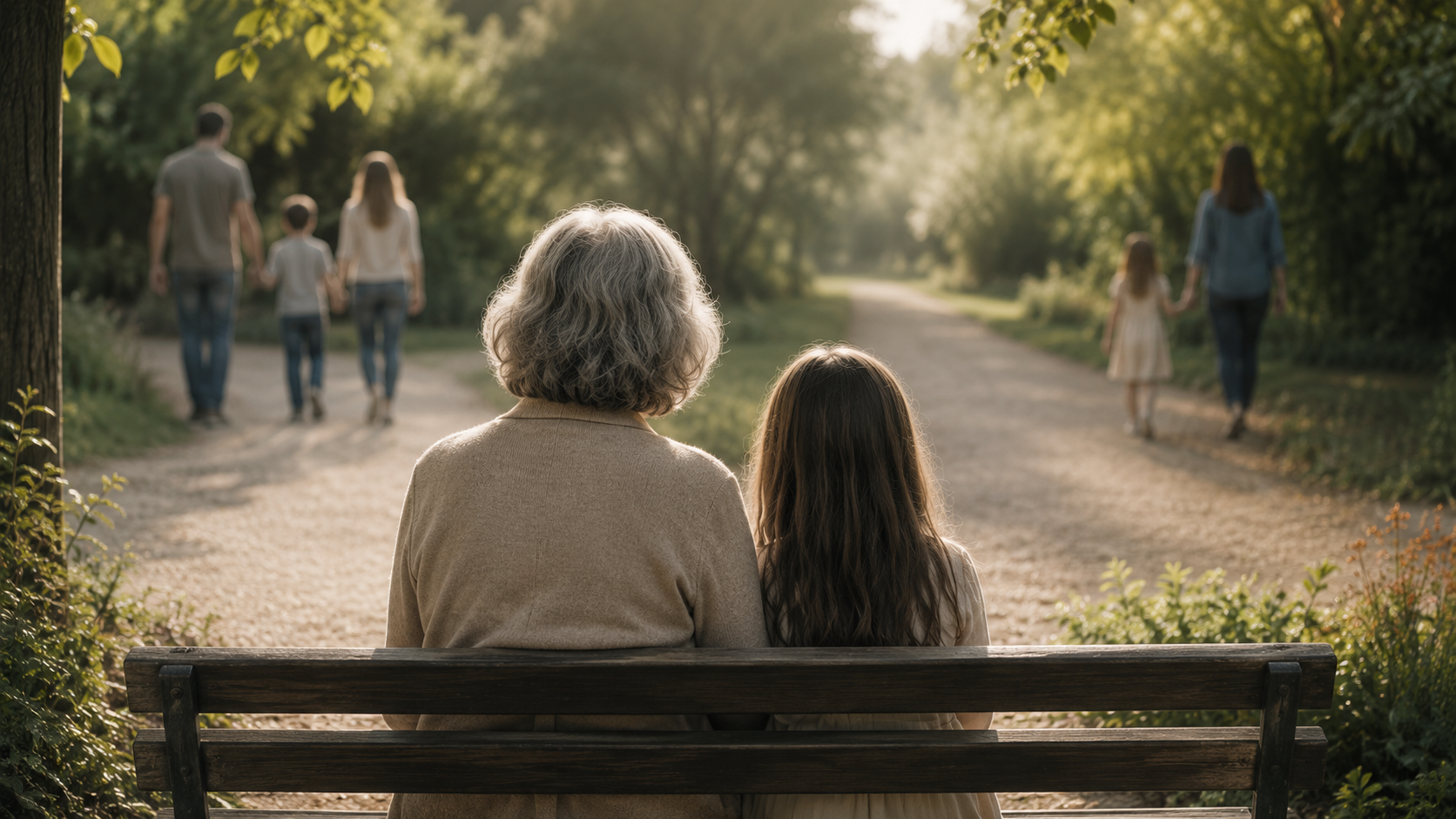
A child stops seeing a grandfather. A girl loses contact with an aunt with whom she shared a very close relationship. A teenager stops spending time with cousins whom he considers part of his closest family.
All of this happens without the child having played any role in the conflict.
As a family mediator in Barcelona, I also observe a worrying reality: situations in which grandparents lose contact with their grandchildren as a result of conflicts with their sons, daughters, sons-in-law, or daughters-in-law are becoming increasingly common.
In many cases, there are no objective reasons that justify such a breakdown.
We are not talking about situations that place children at risk, nor about behaviour that would justify limiting the relationship.
We are simply dealing with conflicts between adults.
And yet, it is the children who bear the consequences.
Beyond Parents: The Importance of the Extended Family
When we talk about family, we usually think of mothers, fathers, and children.
However, family life is far richer and more complex.
Grandparents often play a fundamental role in the lives of many children.
They pass on values. They share experiences. They provide emotional stability. They offer support during difficult times. They help children understand their family history and build their own identity.
But they are not the only ones.
Uncles, aunts, cousins, godparents, and even other close family friends can also play an important role in a child’s life.
That is why, when these relationships disappear as a result of conflicts between adults, it is important to consider the real impact that such a loss may have on children.
What Does the Law Say?
Article 160 of the Spanish Civil Code establishes that a child’s personal relationships with siblings, grandparents, and other relatives or persons close to them may not be prevented without just cause.
The purpose of this protection is not simply to recognise rights for adults.
Its primary objective is to protect the best interests of the child.
For this reason, when courts analyse these situations, the key question is usually the following:
Is maintaining this relationship beneficial for the child?
If the answer is yes and there are no circumstances advising otherwise, the legal system tends to protect these family bonds.
What Do Courts Consider in Conflicts Between Grandparents and Grandchildren?
When it is not possible to reach an agreement within the family, disputes between grandparents and grandchildren may eventually reach the courts.
In such cases, judges do not usually focus on whether grandparents have an absolute right to see their grandchildren.
The main issue is different: determining whether maintaining the relationship is beneficial for the child and serves the child’s best interests.
For this reason, courts generally consider factors such as the quality of the existing relationship between grandparents and grandchildren, the emotional bonds built over time, the child’s own views when age and maturity make this appropriate, and the existence or absence of circumstances that may negatively affect the child’s wellbeing.
Every family is different, and every situation requires an individual assessment.
Precisely for this reason, before a conflict reaches the courtroom, family mediation can provide a space for dialogue where solutions tailored to the needs of all those involved—especially the children—can be explored.
In this way, it is often possible to preserve important family relationships without adding further tension to an already delicate situation.
The Greatly Overlooked Right: The Child’s Right to Be Heard
There is another issue that deserves special attention.
Children have the right to be heard in proceedings that affect them.
However, in practice, it is still common for adults to talk constantly about children without genuinely listening to their voices.
Parents express their views. Lawyers present arguments. Family members explain their positions.
Yet, very often, nobody asks the child how they are experiencing the situation.
Listening to a child does not mean placing upon them the responsibility of making decisions.
It means recognising that they have their own voice and that it deserves to be taken into account.
As a family mediator in Barcelona, I have seen on many occasions that when attention is focused on the real needs of children, the conversation between adults changes completely.
What Rights Do Children Have When Adults Break Family Relationships?
When we talk about conflicts between grandparents, parents, sons, and daughters, we often focus our attention on the rights of adults.
However, children also have rights of their own that must be protected.
The Right to the Child’s Best Interests
Any decision affecting a child should be made with primary consideration given to what is most beneficial for their wellbeing and development.
This principle forms the foundation of all child protection legislation.
The Right to Be Heard
Children have the right to express their views on matters that affect them.
Listening to a child does not mean forcing them to make decisions or placing upon them responsibilities that belong to adults.
It means recognising that they have their own voice and that it deserves to be taken into account.
The Right to Maintain Meaningful Family Relationships
The law protects children’s relationships with their grandparents, siblings, other relatives, and persons close to them when those relationships are beneficial to their development.
For this reason, family ties should not automatically be broken as a consequence of conflicts between adults.
The Right to Preserve Their Family Identity
Children have the right to know and maintain contact with the people who form part of their family history and who contribute to the development of their personal identity.
The Right to Grow Up in an Emotionally Healthy Environment
Children have the right to develop in an environment that promotes their emotional and psychological stability.
Family conflicts are sometimes unavoidable, but adults have a responsibility to minimise their impact on children.
The Right Not to Be Used in Adult Conflicts
Children should never become messengers, unwilling allies, or instruments of pressure in family disputes.
Protecting children means ensuring that they are not burdened with emotional responsibilities that do not belong to them.
All these rights are supported by the United Nations Convention on the Rights of the Child, Spain’s Organic Law 1/1996 on the Legal Protection of Minors, the Spanish Civil Code, and the Civil Code of Catalonia.
Children’s version of the Convention on the Rights of the Child | UNICEF
Children Are Not the Property of Anyone
Children are not the property of anyone.
Today they are sons and daughters. They are also grandchildren, nieces, and nephews.
Tomorrow they will become adults who will form their own opinions about their family history and about the relationships that were either encouraged or prevented during their childhood.
This reflection should accompany us whenever we make decisions that affect our children’s family relationships.
Because adult conflicts may be temporary.
The consequences for children, however, can last for many years.
Family Mediation Can Help
Throughout my work as a family mediator in Barcelona, I have been involved in a wide variety of situations relating to intergenerational conflicts, communication difficulties between parents and children, family disagreements, and cases in which grandparents, grandchildren, and other relatives have lost contact with one another.
My experience has shown me that, in many cases, there is no insurmountable legal problem behind these situations.
What exists is a breakdown in communication.
Family mediation provides a safe and confidential space where people can express their concerns, listen to the needs of others, and explore possible solutions without increasing the level of conflict.
It is not always possible to restore every relationship.
It is not always possible to reach complete agreements.
However, significant progress is often achieved, allowing bridges to be rebuilt that once seemed permanently broken.
When children are involved, every step that improves communication between adults can have a very positive impact on their present and future wellbeing.
If you find yourself in a situation of this kind and are looking for a family mediator in Barcelona, I would be pleased to discuss the available options with you and help you explore possible paths toward dialogue.
Because, in many cases, protecting children also means helping adults learn to listen to one another again.
A Final Reflection
For years, we have asked whether grandparents have the right to see their grandchildren.
It is an important question.
But perhaps it is not the only one.
Perhaps we should also ask whether children have the right to preserve those family relationships that contribute positively to their wellbeing, their emotional development, and the construction of their identity.
Because when adults stop talking to one another, those who may lose the most are precisely those who bear the least responsibility for the conflict.
And that is a reality that, unfortunately, I continue to observe far too often in my work as a family mediator in Barcelona.
Daniel Sererols Villalón
Conflict Mediator and Private Conciliator registered with the Spanish Ministry of Justice, the Centre de Mediació de Catalunya, and the ADR Centre of the Barcelona Bar Association (ICAB). Member of the Associació de Professionals de la Mediació de Catalunya (ACDMA).
Specialised in family mediation in Barcelona and in the out-of-court resolution of family, neighbourhood, inheritance, and business disputes.
◆ Telephone: +34 661 463 306
◆ Email: daniel@mediadorconflictos.com
Barcelona, 20 June 2026.