

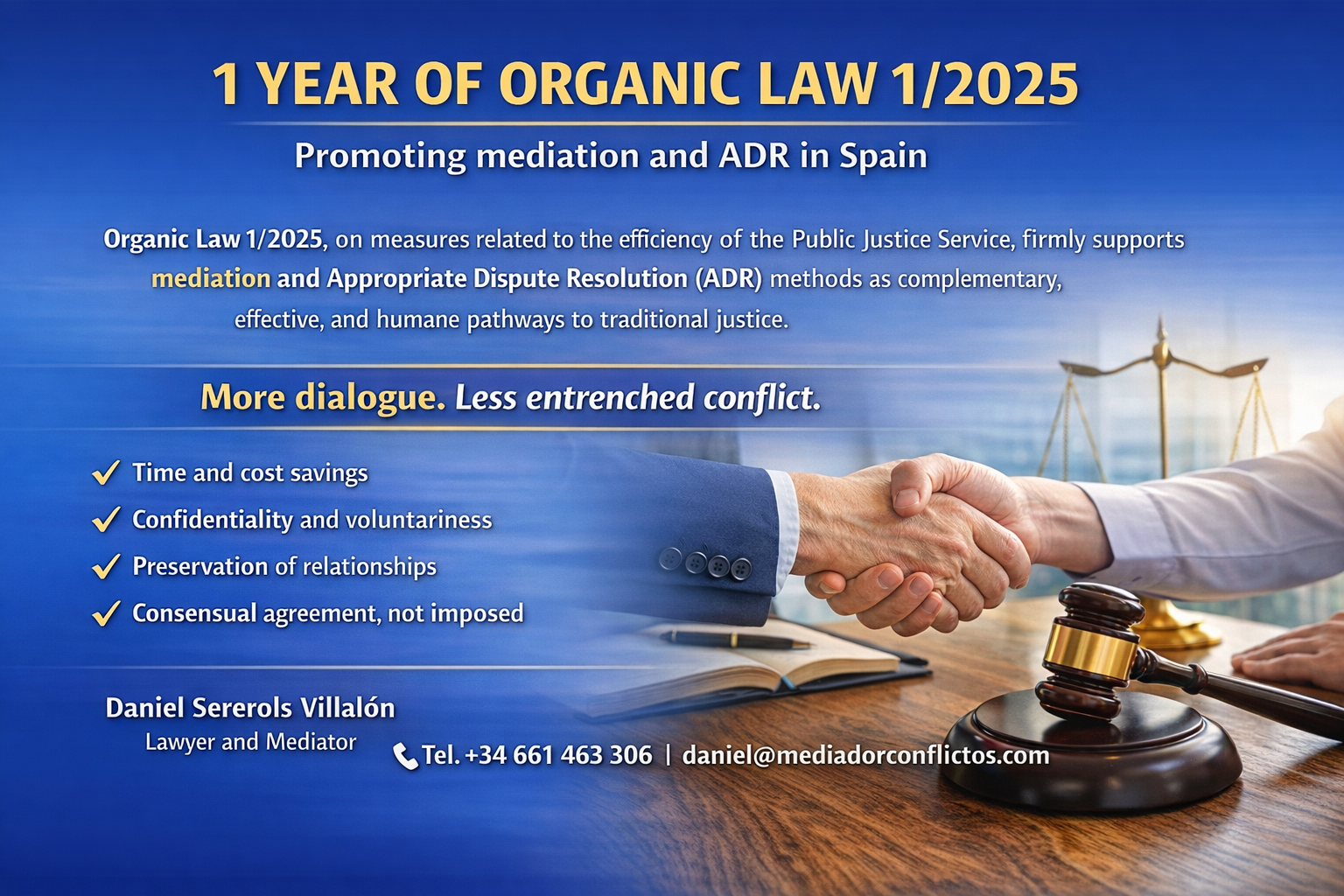
26 Dec One year of Organic Law 1/2025
One year of Organic Law 1/2025: a real opportunity to promote mediation and ADR in Spain
Next 2 January marks the first anniversary of Organic Law 1/2025, on measures relating to the efficiency of the Public Justice Service, a key piece of legislation that represents a paradigm shift in the way conflicts are managed and resolved in Spain.
Although public debate has often focused on judicial reorganisation, one of the most relevant -and at the same time most transformative- pillars of this law is the strengthening of Appropriate Methods of Dispute Resolution (ADR), including mediation, conciliation, assisted negotiation, and other extrajudicial mechanisms.
This first anniversary invites not only reflection, but also a call for time, perspective, and legal pedagogy.
Mediation and ADR: from discourse to practice
Organic Law 1/2025 consolidates an idea that legal professionals, mediators, and international organisations have been defending for years:
Not all conflicts should be resolved in court.
ADR methods are not a lesser alternative nor an obstacle to access to justice, but rather complementary, effective, and fully rights-protecting pathways, particularly suitable for disputes that are:
- Family and inheritance-related
- Neighbourhood and community-based
- Civil and commercial
- Contractual and consumer-related
- Business and corporate
Comparative experience and daily practice show that many conflicts find faster, more humane, and more lasting solutions outside the courtroom.
Clear advantages of extrajudicial dispute resolution
- Time savings
Judicial proceedings can last for years.
Mediation and other ADR methods make it possible to resolve disputes in weeks or months, avoiding unnecessary delays.
- Reduction of economic costs
Fewer procedures, fewer hearings, fewer procedural appeals.
Extrajudicial resolution involves lower direct and indirect costs, both for the parties and for the justice system.
- Preservation of personal and professional relationships
In mediation, there are no winners or losers.
Dialogue, shared responsibility, and respect are encouraged — essential elements in conflicts between family members, business partners, neighbours, or companies with ongoing relationships.
- Confidentiality
Unlike judicial proceedings, mediation is confidential, protecting the privacy, reputation, and sensitive information of the parties.
- Voluntariness and party empowerment
The people involved decide on their own conflict, with professional support but without external impositions.
- More stable and better-complied agreements
Agreements reached through mediation usually show a higher level of compliance, as they are based on consensus rather than an imposed court ruling.
A cultural change that requires time
Some critical voices have pointed out difficulties, dysfunctions, or uncertainties in the application of Organic Law 1/2025. However, it is important to recall a fundamental fact:
The effective implementation of ADR methods began in practice in April, and shortly afterwards came the summer period, traditionally marked by reduced activity.
Attempting to definitively assess a structural reform of this magnitude within such a short time frame is not realistic.
Mediation and ADR are not consolidated by legislation alone, but through:
- Training
- Practical experience
- Public trust
- Involvement of legal professionals
- Time
Mediation and the legal profession: allies, not adversaries
Another essential aspect is to dispel the false dichotomy between mediation and legal advocacy.
Organic Law 1/2025 does not weaken the role of lawyers; rather, it expands and enriches it.
The lawyer:
- Advises
- Accompanies
- Protects rights
- Ensures the legality of agreements
Mediation does not exclude legal representation; instead, it places it within a more efficient and solution-oriented framework.
The role of the Barcelona Bar Association (ICAB)
During this first year of implementation of Organic Law 1/2025, special recognition is due to the role played by the Barcelona Bar Association (Il·lustre Col·legi de l’Advocacia de Barcelona – ICAB), which has maintained a proactive, constructive, and facilitative approach throughout the year in relation to the implementation of this legislation. Through numerous conferences, seminars, and training spaces, the Bar Association has made a decisive contribution to the legal pedagogy necessary to understand the real scope of the law and the role of mediation and Appropriate Methods of Dispute Resolution (ADR). Always starting from an essential premise -that some conflicts must be resolved in court, while others find a more appropriate response through extrajudicial means- the ICAB has promoted an integrative and realistic vision of professional legal practice. In addition, the provision of mediation rooms within its ADR area constitutes a fundamental resource that facilitates the effective practice of mediation and reinforces the institution’s commitment to a more efficient, accessible, and dialogue-oriented justice system.
A first anniversary to consolidate, not to delegitimise
This first anniversary of Organic Law 1/2025 should serve to:
- Strengthen confidence in ADR
- Improve its practical application
- Correct dysfunctions
- Listen to professionals
- Commit to a more accessible, sustainable, and humane justice system
Focusing solely on the shortcomings of a young law, without allowing it to mature, does not help improve the system, but rather perpetuates its overload.
Conclusion: more dialogue, less entrenched conflict
Mediation and appropriate methods of dispute resolution are neither a passing trend nor an imposition, but a coherent response to a complex social and judicial reality.
One year on, Organic Law 1/2025 represents a real opportunity to:
- Relieve the burden on the courts
- Empower citizens
- Resolve conflicts in a faster, more cost-effective, and more humane way
Let us give time to change.
Let us give space to dialogue.
And let us continue building a justice system that not only resolves disputes but also repairs and pacifies.
Contact without obligation:
Daniel Sererols Villalón, lawyer and mediator
📞 Tel. +34 661 463 306
📧 daniel@mediadorconflictos.com