

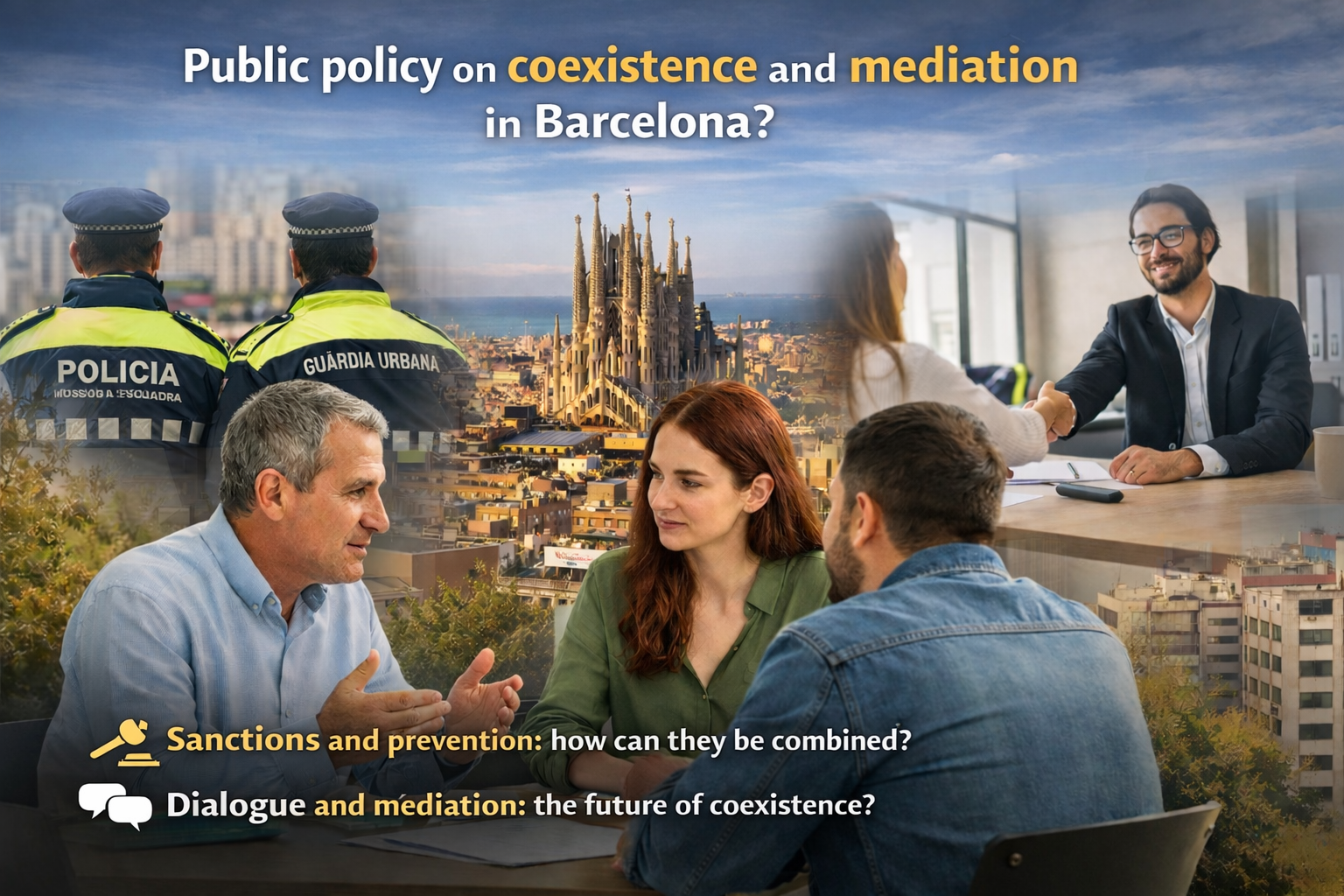
27 Dec “When will there be a public policy on coexistence and mediation?”
“When will there be a public policy on coexistence and mediation?”
This is the question that was posed on December 24, 2025 by Javier Wilhelm Wainsztein, psychotherapist for adults, adolescents and couples, and professional mediator in the family and organizational fields. This reflection arose following a post I shared on LinkedIn about the last annual meeting of the Barcelona City Council (Consell de Ciutat de Barcelona), a key institutional space for participation, dialogue and reflection on the city.
Far from being a rhetorical observation, the question contains a deep interpellation regarding the model for managing conflicts in our cities, and more specifically regarding the place that mediation occupies -or should occupy- within public policies on coexistence, particularly in Barcelona.
Mediation, yes – but as a public policy?
For years, Barcelona has had services, programs and mediation professionals in a wide range of areas: neighbourhood, community, intercultural, housing, public space and consumer matters. There are accumulated experience, technical expertise and qualified professionals.
However, from a structural perspective, it is worth asking whether mediation truly operates as a city-wide public policy, or rather as a set of dispersed resources, managed by different municipal departments and, in many cases, accessed mainly through district-level channels.
A public policy is not defined solely by the existence of services. It implies:
- Explicit political priority
- Visible institutional leadership
- Coherence across policy areas (coexistence, security, justice, social services, housing)
- Continuity over time
- Evaluation, public education and a clear narrative addressed to citizens
It is precisely at this point that the question posed by Javier Wilhelm Wainsztein acquires its full meaning.
The contrast with other municipal models: the case of L’Hospitalet de Llobregat
Within the metropolitan area, there are particularly interesting models, such as that of L’Hospitalet de Llobregat, which has opted for a clearly identifiable Community Mediation Service, with a centralized point of entry, a recognizable team, a visible coordinator, and effective coordination with other municipal services, including those related to coexistence and public safety.
This model does not eliminate the complexity of urban conflict, but it does provide:
- Institutional clarity
- Accessibility for citizens
- Clearly defined referral pathways
- A coherent political narrative on coexistence and mediation
The aim is not to mechanically transfer one model from one municipality to another, but rather to acknowledge that the institutional centrality and visibility of mediation strengthen its effectiveness and social legitimacy.
Coexistence, incivility and a political opportunity in Barcelona
Barcelona is currently at a particularly significant moment in terms of urban coexistence. The City Council is promoting decisive policies to combat incivility, including the reform of municipal ordinances, with the aim of updating a regulatory framework that largely dated back to 2005.
These measures, necessary and in many respects well-founded, strengthen the municipality’s capacity to intervene in response to uncivil behavior. However, any effective coexistence policy must go beyond regulation and punishment.
Sanctions are essential in certain cases, but they cannot be the sole response. Prevention, dialogue and mediation are fundamental tools to prevent the entrenchment of conflicts, reduce repeat offenses, and preserve neighborhood and community relationships.
The reform of the Coexistence Ordinance: what has been approved and what will enter into force
From a technical standpoint, it is important to clarify the current status of the reform of Barcelona’s Coexistence Ordinance (or Civility Ordinance) in order to properly frame the debate.
The new text of the Ordinance was approved by the City Council Plenary Session in December 2025, completing a review process of a regulation that had been in force for nearly two decades. The reform introduces an updated framework, with new offenses, aggravating circumstances and mechanisms designed to improve the effectiveness of municipal action against incivility.
However, the entry into force and practical application of this regulation are not immediate. Following plenary approval, the required administrative procedures -official publication and statutory time limits- must be completed, meaning that its effective implementation is scheduled for some time during 2026, most likely in the first months of the year.
It is particularly important to highlight that the reform is not limited to stricter sanctions, but also incorporates a preventive and social approach, including references to alternative measures and mediation mechanisms in those cases where an exclusively punitive response proves ineffective, especially in contexts of vulnerability.
This timeline and approach make the reform of the Ordinance a strategic opportunity for Barcelona to accompany regulatory reinforcement with a clear and explicit definition of its public policy on mediation and coexistence, integrating sanctions, prevention and dialogical conflict management within a single coherent framework.
Mediation and authority: a false dichotomy
One of the major misunderstandings in public debate is the opposition between mediation and public order. These are not opposing concepts, but rather complementary ones.
A mature city is one that:
- Sanctions when necessary
- Uses mediation when possible
- Prevents conflicts before they escalate
Mediation does not weaken authority; on the contrary, it strengthens it by intervening before conflicts become entrenched and ultimately end up being judicialized or repeatedly sanctioned.
A question that challenges the city
The question posed by Javier Wilhelm Wainsztein is not addressed to a specific professional or a particular group. It is addressed to the city as a political project:
Do we want to continue managing conflicts only once they erupt,
or do we want to build a public policy on coexistence that is also based on dialogue?
Barcelona has the professional talent, accumulated experience and regulatory framework necessary to take this step. What is lacking is turning mediation into a clear, visible and structural political commitment, recognizable to citizens and sustained over time.
Conclusion: the time is now
The reform of municipal ordinances, Organic Law 1/2025, and the growing complexity of urban coexistence make this a particularly appropriate moment to respond to the question that gives this article its title:
When will there be a public policy on coexistence and mediation?
The answer may not be a specific date, but rather a courageous political decision – one that understands mediation not as an ancillary resource, but as an essential pillar of democratic coexistence.
Contact without obligation:
Daniel Sererols Villalón, lawyer and mediator
📞 Tel. +34 661 463 306
📧 daniel@mediadorconflictos.com