
23 Jan When Health Enters into Conflict: Mediation to Build Agreements
When Health Enters into Conflict: Mediation to Build Agreements
Reflections on the European Day of Mediation (2026)
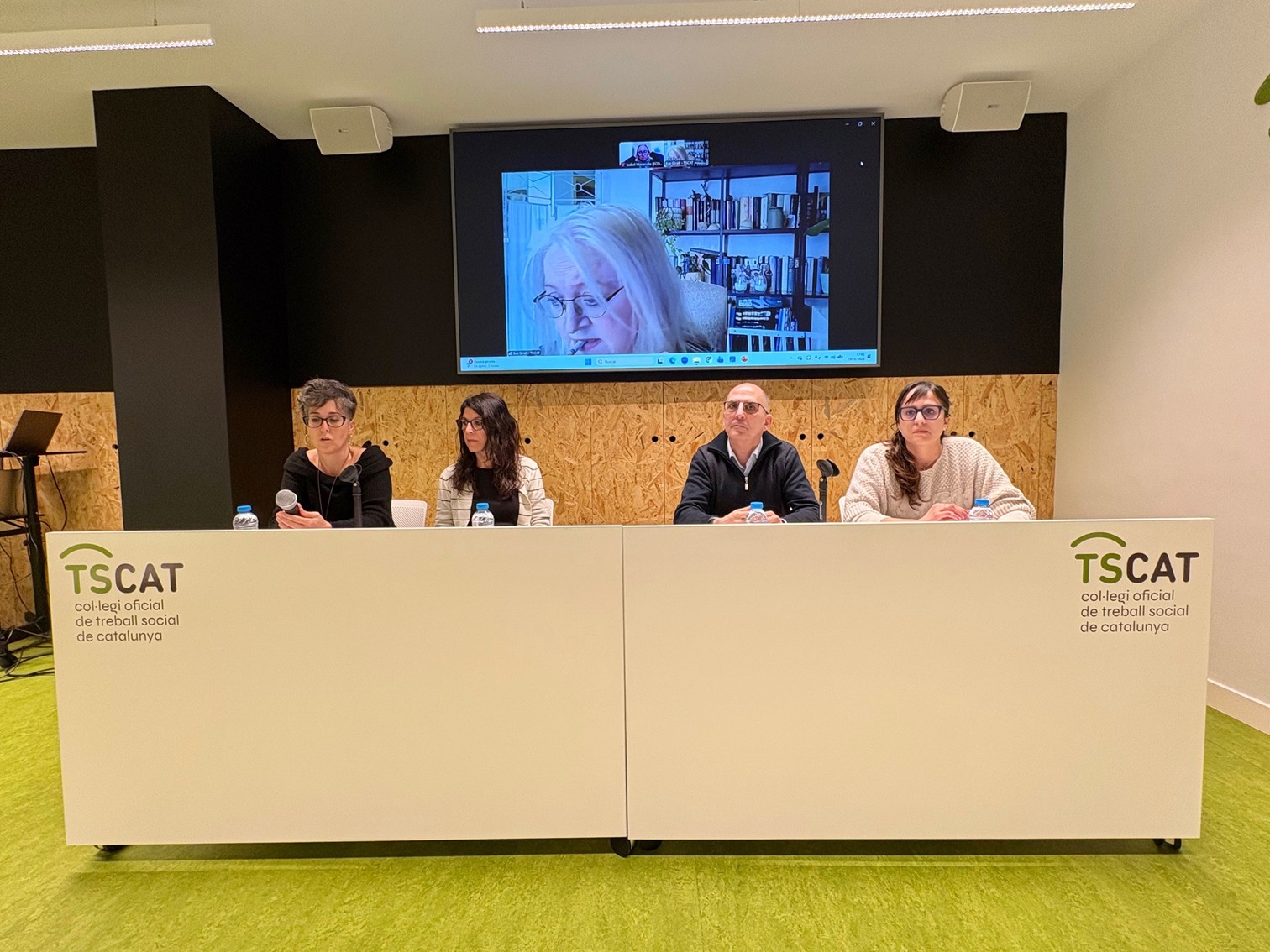
On January 19, I had the opportunity to attend the round table “When Health Enters into Conflict: Mediation to Build Agreements”, an event organized on the occasion of the European Day of Mediation by the Mediation Commission of the Official Association of Social Work of Catalonia (TSCAT), with the active involvement of the Mental Health Commission.
I would like to begin this article by expressing my sincere gratitude to Gemma Pellicé Gibernau, mediator, member of the Official Association of Social Work of Catalonia, and colleague at FP La Salle Gràcia, for personally inviting me to participate in this space for reflection. Thank you, Gemma, for thinking of me and for enabling my attendance at a day that was deeply inspiring, rigorous, enriching, and educational, which allowed me to learn, reflect, and broaden my perspective on mediation in the field of health.
A Special Dedication
I would also like to dedicate this publication to Sara Daví and her team. My former mediation professor, she was the person who opened the doors for me to knowledge and to the real practice of mediation in the healthcare field. Whenever I face complex health-related situations, I recall her guidance, her perspective, and her way of understanding mediation, which is both rigorous and profoundly human.
Health Mediation: Much More Than Conflict Management
Health mediation currently represents one of the areas with the greatest potential within conflict mediation and MASC (Appropriate Means of Dispute Resolution). It is a field where intense emotions, vulnerability, healthcare pressure, complex family dynamics, and decisions with major personal, social, and community impact converge.
In this context, the health mediator becomes a key figure in facilitating dialogue, restoring relationships, building trust, and creating safe spaces for communication, especially when those involved are going through moments of emotional fragility.
During the session, an idea was shared that accurately captures the essence of mediation:
“When a person entrenched in their position feels understood, they may become willing to speak.”
This sentence condenses a profound truth: understanding opens the door to dialogue, and dialogue allows conflict to be transformed into opportunity.
Healthcare Mediation and Health Mediation: Distinct Concepts
One of the most relevant aspects of the session was the clear distinction between healthcare mediation and health mediation, two realities that are often confused but conceptually different.
Healthcare mediation mainly focuses on the organization of healthcare services, care pathways, relationships between professionals and institutions, and the management of conflicts that arise in these environments.
Health mediation, by contrast, places the focus on the person, their family, social, and community environment, and the emotional, relational, and life impact generated by conflict situations.
This human-centered approach turns health mediation into a tool of great restorative value, capable of fostering emotional repair processes and rebuilding meaningful relationships.
The Transformative Value of Healthcare Mediation
Healthcare mediation plays a fundamental role in defending the rights of people with adaptive needs, promoting full inclusion in decision-making and preventing vulnerability from becoming a disadvantage.
It also becomes a space for active listening for users, professionals, and families, facilitating mutual understanding, reducing tensions, and constructively managing emotionally complex situations. This dialogical space allows relationships to be rebuilt, trust to be restored, and medicine to be rehumanized, placing the person back at the center of the system.
In practice, healthcare mediation is particularly useful in:
– Intra-family conflicts related to personal care, caregiving, dependency, or sensitive decision-making.
– Conflicts between users and/or families and healthcare centers, services, or professional teams.
– Interprofessional conflicts within healthcare teams, fostering cohesion, cooperation, and a positive work environment.
Thus, healthcare mediation does not merely manage conflicts; it transforms relationships, improves care processes, and contributes to more humane, empathetic, and efficient healthcare delivery.
Mediation as an Emotionally Healing Process
One of the major insights of the day was recognizing that mediation can be emotionally healing. It is not only about reaching agreements, but also about restoring relationships, healing emotional wounds, and fostering mutual understanding.
In contexts of mental health, functional diversity, dependency, or chronic illness, mediation provides a safe space where tensions are reduced, conflict escalation is prevented, care is humanized, shared decision-making is encouraged, and the quality of life of all involved is improved.
Mediation thus becomes an essential complement to healthcare and social systems, contributing a relational dimension that often remains invisible.
Professional Experience: Mediation and Mental Health, a Possible Reality
From my experience as a professional mediator, I have had the opportunity to accompany processes involving people diagnosed with schizophrenia, autism spectrum disorders, severe depression, and other mental health conditions. These experiences have allowed me to confirm that mediation is possible – and often highly valuable – in these contexts, provided that there is an appropriate environment, relevant methodological adaptations, and deep respect for each person’s rhythms and needs.
This round table was particularly enriching and insightful for me, as it enabled me to deepen my understanding of these realities, exchange perspectives with other professionals, and reaffirm a deep conviction: people with mental health conditions must be able to actively participate in mediation processes.
I am a firm advocate of their right to be heard, recognized, and empowered, avoiding paternalistic or exclusionary approaches. When properly conducted, mediation can offer them a safe space in which to express themselves, better understand the conflicts they face, and build meaningful agreements.
Can Mediation Take Place Within Public Administrations?
One of the most stimulating moments of the session was the reflection proposed by Artur Román, when he posed a question that was both direct and highly relevant: can mediation take place within public administrations?
Personally, I was very positively impressed by the reasoning he developed in response, referring to Law 39/2015, of October 1, on the common administrative procedure of public administrations, and highlighting the real possibilities of integrating mediation and MASC into the ordinary functioning of institutions.
Specifically, Article 86.1 of this law opens the door to the conclusion of agreements, pacts, conventions, or contracts, which may serve to bring administrative procedures to an end or be incorporated into them at an earlier stage. This legal framework fully legitimizes the incorporation of mediation into administrative activity and allows progress toward a more dialogical, efficient, humane, and consensus-oriented public administration, capable of preventing litigation, reducing conflict, and improving relations with citizens.
The Fundamental Role of TSCAT and the Catalan Society for Health Mediation
I would particularly like to highlight the work of the Mediation Commission of TSCAT, as well as the committed involvement of the Mental Health Commission, which made possible a day of exceptionally high professional, academic, and human quality.
Likewise, the Catalan Society for Health Mediation deserves special recognition. It brings together highly committed professionals such as Artur Román, Carles Garcia Roqueta, Mercè Alaball, and many others, who work tirelessly to consolidate this emerging field.
A Call for Participation by Social Work Professionals
Taking advantage of this reflection, I would like to encourage all social workers interested in mediation, MASC, and positive conflict management to become actively involved in the Official Association of Social Work of Catalonia and its Mediation Commission.
📩 mediacio@tscat.cat
Your participation is key to continuing to build strong, interdisciplinary, inclusive, and transformative mediation.
Conclusions: Caring for People, Restoring Relationships, Building Coexistence
The event “When Health Enters into Conflict: Mediation to Build Agreements” reaffirmed a profound conviction: health mediation and healthcare mediation do not merely resolve conflicts; they care for people.
In an increasingly fast-paced, tense, and fragmented world, mediation offers time, dialogue, listening, and recognition — four essential elements for rebuilding relationships and fostering coexistence.
As a conflict mediator, private conciliator, and professional in MASC, I am convinced that health mediation represents a field of both present and future relevance, with enormous potential to humanize relationships, improve institutional quality, and contribute to a more dialogical, just, and cohesive society.
Contact:
Daniel Sererols Villalón
Lawyer and mediator
📞 661 463 306
✉️ daniel@mediadorconflictos.com