

23 Dec The Barcelona City Council
The Barcelona City Council: coexistence and the neighbourhood movement for a more welcoming city
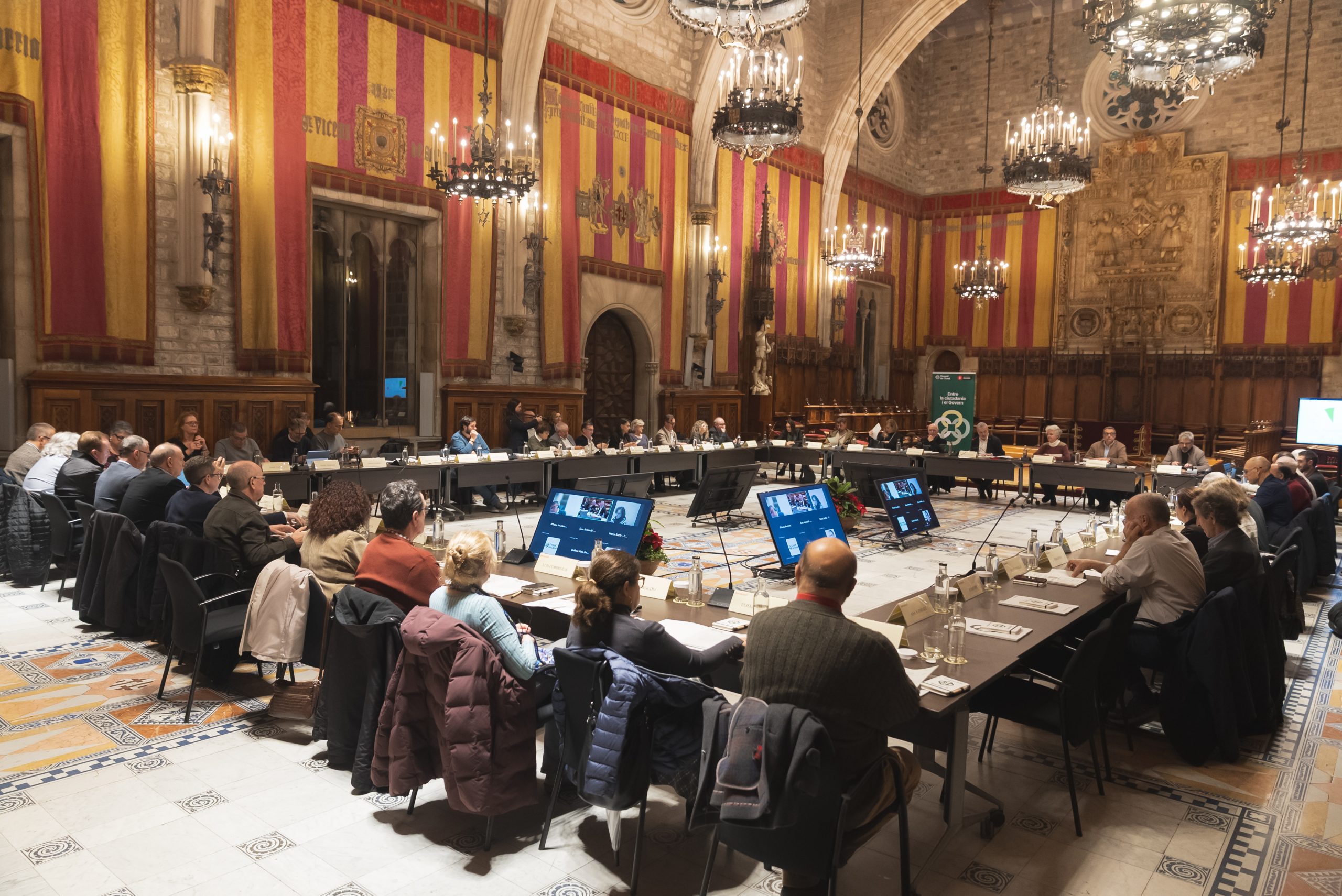
Last Tuesday, 16 December, the Plenary Session of the Barcelona City Council was held, the city’s highest consultative and citizen participation body, in a session chaired by Mr Jaume Collboni, Mayor of Barcelona. The plenary session once again highlighted the importance of this space as a meeting point for institutions, organised civil society and the neighbourhood movement, in order to reflect collectively and influence the city’s public policies.
I participated in this plenary session as a neighbourhood representative of the Sants-Montjuïc District, exercising the representation of the district’s eight neighbourhood councils, as territorial participation spaces that channel residents’ voices on key issues such as coexistence, public space, housing and community services. This close-up perspective provides the City Council with a view rooted in neighbourhoods and in the everyday conflicts that arise within them.
The session was also attended by various relevant institutional and social representatives, including Marc Serra, former councillor of the Sants-Montjuïc District, with a career closely linked to neighbourhood policies, citizen participation and urban coexistence, as well as Mr Pedro Aguilera Cortés, Commissioner for Participation of Barcelona City Council, responsible for promoting and strengthening participatory democracy spaces in the city.
During the plenary session, several opinions of great relevance for the present and future of Barcelona were approved: Barcelona Kind and Friendly: a space for everyone to live together; Budgets and fiscal ordinances 2026; and Measures related to housing in Barcelona.
From a conflict mediation and ADR (MASC) perspective, this article focuses on those elements of the plenary session that are directly connected to urban coexistence, community work and the essential role of the neighbourhood movement.
The Barcelona Kind and Friendly opinion represents a clear commitment to a city model based on coexistence, shared civic responsibility and conflict prevention. In a diverse and complex city such as Barcelona, conflict is part of everyday life; the challenge is not to avoid it, but to manage it appropriately.
From this perspective, the opinion reinforces a fundamental idea: not every conflict should receive a punitive or police response. Many situations can and should be addressed through dialogue tools, community mediation, social education and preventive intervention, in coherence with Alternative Dispute Resolution mechanisms and with a long-standing Barcelona tradition of dialogic conflict management in neighbourhoods.
One of the most relevant aspects of the debate was the recognition of the role of neighbourhood educators and night-time mediators as key figures in managing coexistence, especially in nightlife environments and during sensitive time slots.
Within this framework, the figure of the night mayor and the work of the Night Council were highlighted, as spaces designed to coordinate policies on coexistence, leisure and the use of public space. It should be noted that these bodies do not include municipal police, and that their essence is preventive, educational and mediatory, not punitive.
The work promoted by Ms Zapata, linked to night-time policies, is particularly relevant, as it focuses on accompaniment, mediation and conflict reduction. In this context, it is unjust and incorrect to label night-time mediators as a supposed undercover police force, a claim that completely distorts their real function and renders invisible work that is essential for urban coexistence.
The City Council debate also made it possible to connect these reflections with the evolution of Barcelona’s municipal ordinances. In this regard, it should be borne in mind that Barcelona City Council is updating and strengthening municipal ordinances to sanction uncivil behaviour, with a significant tightening of fines for incivility.
This regulatory change is embodied in the new Coexistence or Civility Ordinance, which, once definitively approved and officially published, is expected to enter into force in February 2026. The reform expands the catalogue of sanctionable conduct and increases the amounts of certain fines, particularly in relation to the improper use of public space and nightlife.
This new scenario poses an important challenge: how to articulate a stricter sanctioning regime with preventive, educational and mediation policies, so that the tightening of sanctions does not replace or displace the work of street educators, community mediators and coexistence services that operate from a proximity-based approach.
The neighbourhood movement continues to be a fundamental pillar of the City Council. Neighbourhood associations, the AVV Plaça de la Farga, and the Neighbours’ Federation all play a key role in defending social rights, housing and coexistence in neighbourhoods, as well as in strengthening spaces for citizen participation in the city.
I would like to expressly dedicate this publication to Carolina Torredemer, President of the Neighbours’ Federation, and to Andreu Rojas, member of the board of the same Federation, for their constant, rigorous and generous commitment to the city, and for their active involvement in participatory spaces such as the Barcelona City Council.
Finally, it should be highlighted that the Safeguards Commission of the City Council has already been constituted, a fundamental instrument for guaranteeing the participation rights of citizens and organisations. Its implementation strengthens the role of the Council as a genuine space for participatory democracy and protection against possible institutional dysfunctions.
The Plenary Session of the Barcelona City Council of 16 December reflects a city in transformation, debating how to combine regulation and coexistence, sanction and prevention, security and social cohesion. From the perspective of conflict mediation and ADR (MASC), and from neighbourhood representation, the challenge is clear: to build a kind and friendly Barcelona that regulates when necessary, but that firmly commits to dialogue, community work and neighbourhood involvement as central pillars of coexistence and cohesion.
Daniel Sererols Villalón, lawyer and conflict mediator
AVV Plaça de la Farga (Neighbours’ Federation) · Member of the Barcelona City Council · Neighbourhood representative of the Sants-Montjuïc District
Tel. 661.463.306
Barcelona, 23.12.2025