
14 Feb Systemic Law, Life Purpose and Career Choice
Systemic Law, Life Purpose and Career Choice: a Transformative View for Mediation and Education
In the field of conflict mediation and new ways of understanding law, in recent years an approach has been gaining relevance that brings human depth, contextual understanding and a broader vision of reality: systemic law. It is not only a legal current, but a way of looking at relationships, conflicts and life decisions from an integrative perspective that connects the personal, the family, the social and the professional.
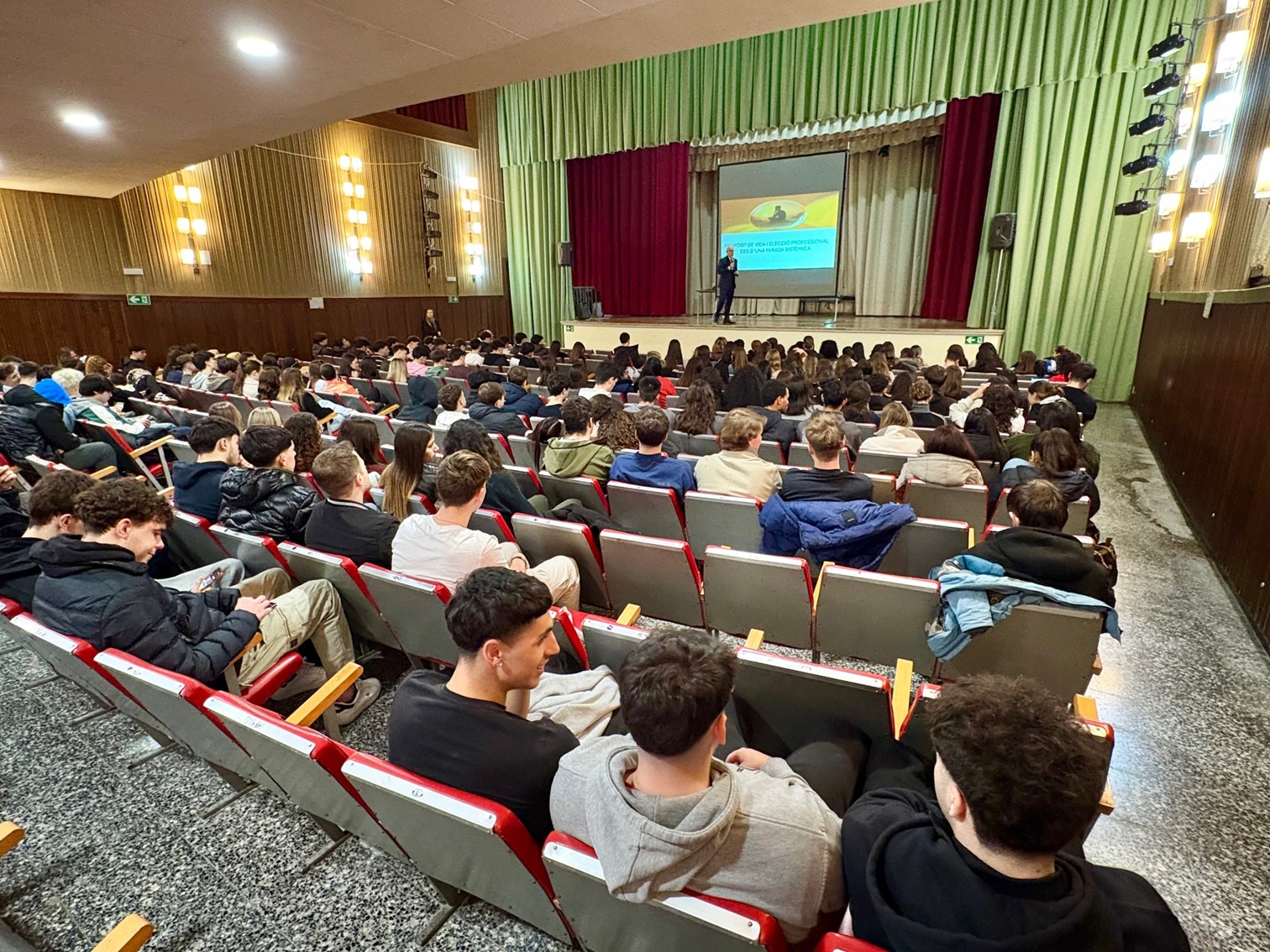
Precisely this perspective was the central axis of the visit carried out on Friday, February 13, 2026 by Enric Soriano Ortín to La Salle Gràcia, where he delivered a presentation of great pedagogical value aimed at vocational training students. Enric Soriano is currently considered a European reference in systemic law and mediation, and his presence represented an exceptional opportunity to bring students closer to concepts that are not usually addressed in the traditional academic curriculum but which are essential for their personal and professional development.
It is also worth highlighting that Enric Soriano is an active member of the Barcelona Bar Association, an institution of which the author of these lines is also a member. We share not only the profession of lawyer, but also the status of registered mediators within that bar association, which reinforces the connection between legal practice, conflict mediation and the systemic approach from a common professional base.
What is systemic law?
Systemic law is a current that integrates legal knowledge with contributions from systemic psychology, family constellations, mediation and the facilitation of dialogued solutions. It is based on the idea that legal problems are not only normative issues, but manifestations of deeper human dynamics that involve relationships, family histories, invisible loyalties and recurring patterns.
This approach does not replace traditional law; it complements it. It invites legal professionals – lawyers, mediators, conflict facilitators and legal operators in general – to broaden their perspective in order to better understand the origin of disputes and promote more conscious, sustainable and respectful solutions for all the parties involved. In this sense, systemic law naturally connects with conflict mediation, the culture of agreement and the search for solutions that take into account not only the rule, but also the people.
The concept of system and the systemic perspective
When we speak of a “system” we refer to a set of interrelated elements that influence one another. A family is a system, a company is a system, a classroom is a system, and even a professional trajectory can be understood as part of a larger system. The systemic perspective proposes observing not only the isolated fact, but also the network of relationships, influences and contexts that surround it.
This way of understanding reality has roots in different countries and disciplines. In Brazil, for example, Judge Sami Storch has been one of the pioneers in incorporating systemic dynamics into the judicial field. In the European and Spanish context, various jurists, trainers and specialized authors have published works and developed training programs on systemic law, contributing to its expansion and consolidation as a complementary approach to classical law.
Life purpose and career choice
Enric Soriano’s presentation at La Salle Gràcia was not limited to a theoretical explanation. It connected systemic law with a particularly relevant issue for vocational training students: life purpose and career choice. Through brief, safe and non-invasive dynamics, students were able to reflect on their personal history, their talents, family influences and the coherence between their studies and their life project.
This approach is especially timely at a stage in which many students are deciding on their entry into the labor market or redefining their trajectory. Understanding why a path is chosen, what talents one possesses and what values sustain that choice provides clarity, motivation and meaning. From the perspective of mediation and conflict management, this inner work also fosters emotional maturity, personal responsibility and the capacity for dialogue, key competencies both in the professional sphere and in everyday life.
Education, mediation and pedagogical value
The day also had a symbolic component. It was a rainy Friday, meteorologically unstable, and yet the session brought reflection, serenity and positive energy at a moment of usual end-of-week fatigue. The use of images, practical examples and guided exercises helped maintain attention and generate an atmosphere of conscious participation. The photographs taken during the session precisely reflect that climate of interest and connection.
The presence of speakers specialized in areas such as mediation, relational skills or the systemic perspective reinforces the pedagogical value of educational centers that are committed to comprehensive education. Some time earlier, students had already enjoyed the intervention of Amina Menni with a brilliant presentation on soft skills, and now Enric Soriano’s visit consolidated this line of openness toward knowledge that combines law, personal development and the facilitation of solutions.
In this context it is also fair to recognize the involvement of professionals from the educational center itself, such as Marta Carruesco and Gemma Pellicé, teaching colleagues committed to the integral formation of students. In the case of Gemma Pellicé, in addition to her teaching work, her role as a mediator and her marked systemic profile in professional practice stand out, which adds value both to her training activities and to her way of addressing problems and conflict resolution. This combination of teaching, mediation and social intervention from a systemic perspective notably enriches educational processes and spaces for personal and group support.
Systemic law and conflict mediation
From the perspective of conflict mediation, systemic law offers particularly valuable tools. It allows us to understand that behind a legal dispute there are often emotions, unresolved histories, frustrated expectations and complex relational dynamics. Integrating this perspective does not mean abandoning legal norms, but rather enriching them with a human dimension that favors more lasting agreements and more balanced solutions.
For those of us who work in mediation, solution facilitation and conflict management, this current represents an opportunity for professional evolution. It invites us to listen beyond words, to observe contexts and to understand that every conflict is also a possibility for learning and transformation.
Enric Soriano’s visit to La Salle Gràcia was, ultimately, an example of how law, mediation and personal development can engage in dialogue with one another. At a key moment for students preparing to enter the labor world, introducing concepts such as life purpose, systemic perspective and personal responsibility not only enriches their academic education, but also contributes to forming more conscious, more dialoguing and better prepared professionals to manage conflicts and build solutions in increasingly complex environments.
Barcelona, February 14, 2026
Daniel Sererols Villalón
Tel. (34) 661 463 306