

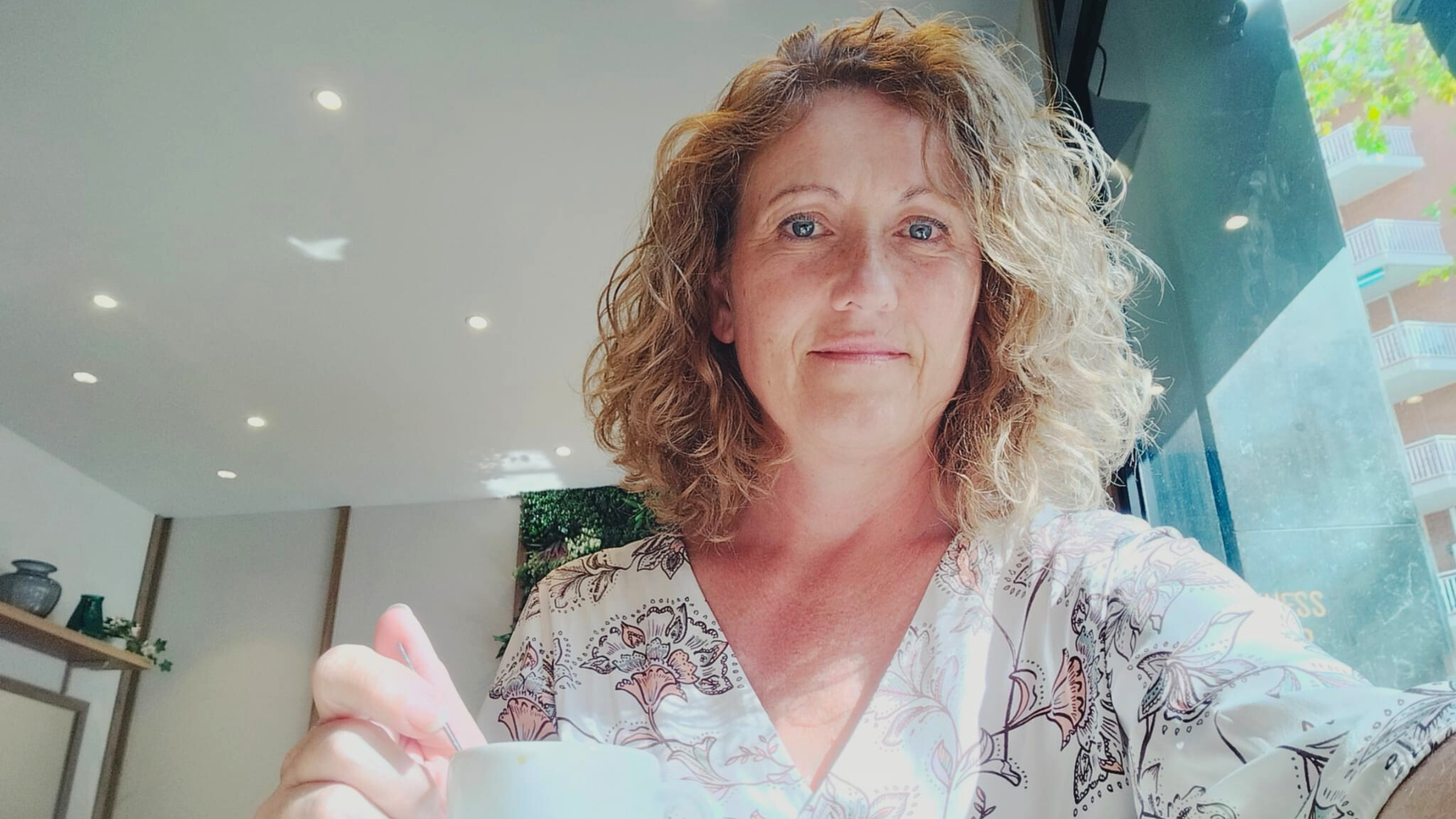
13 Dec Núria Pallach, therapist specialized in stress and anxiety
Núria Pallach, therapist specialized in stress and anxiety
There are encounters that are not accidental, but deeply meaningful. Meeting Núria Pallach was one of them. It was thanks to Núria Cortés i Fusté and Santi Martín, from Occident, within the framework of a warm BNI GLOBAL meeting in Barcelona, where it quickly became evident that behind the therapist specialized in stress there is a professional with a deep, serene, and transformative perspective on emotional well-being.
In this interview, Núria shares her personal and professional journey, her way of understanding stress and anxiety as signals — and not as enemies —, and the importance of listening to the body, emotions, and mind as a whole. We also talk about conflict, mediation, internal coherence, and about how therapeutic work can become a true inner mediation that facilitates real and lasting changes, both on a personal and relational level.
A serene and lucid conversation that invites us to stop, look inward, and remember that asking for help can be the first step toward a life with more calm, clarity, and coherence.
1. Who is Núria Pallach, beyond being a therapist specialized in stress? How did you come to integrate emotional awareness into your support work?
The search for well-being and inner freedom has been the guiding thread of my entire life. Through a very deep personal process, I have been discovering how to release unconscious fears, limiting beliefs, blockages, and insecurities that condition us without our realizing it. The techniques I use in consultation are precisely those that I first applied to myself and that have allowed me to transform myself in a real and sustainable way. For me, truly looking at yourself, becoming your own best ally, and living in coherence with yourself is one of the most important victories a person can achieve.
2. On your LinkedIn profile and on your website you speak about “evidence-based therapeutic proposals” to reduce stress and anxiety. What was the key moment that led you to choose this path?
Stress and anxiety are often only the tip of the iceberg: a warning that something deeper needs to be listened to. On my own path, I discovered that the origin of discomfort is not frightening when you have the tools to look at it head-on. What is truly frightening is living with your back turned to what makes you suffer.
I work with techniques that humanity has been using for centuries — and that science now supports — because they are effective in calming the nervous system and rebalancing body and mind. Current scientific evidence simply confirms what ancient civilizations already knew. Today, many people need to “touch the proof,” and studies are that proof.
3. What type of person usually contacts you? What human or emotional profile do you find behind anxiety and chronic pain?
I mainly work with professional women and executives who take on high levels of responsibility and have learned to prioritize others before themselves. The common pattern is: self-demand, omission of one’s own needs, a frenetic pace, and a feeling of guilt when they try to stop. I also work with people of all profiles, but most arrive seeking a regulation that allows them to perform without paying for it with their health.
4. Explain how you cooperate with medical professionals. How does this integrative approach work?
My work is complementary and always respects medical criteria. I never advise against a treatment; doing so would be irresponsible. Medicine plays a key role, and holistic therapy provides tools for emotional and bodily self-regulation that enhance results.
When a person is undergoing treatment for chronic pain, anxiety, depression, or stress, combining it with the work we do in consultation often accelerates improvements and helps integrate changes in a deeper and more stable way.
5. Many people try to “hide” anxiety. What invisible signs do you detect, and what do you work on first?
One of the most common signs is avoiding silence and constantly seeking stimulation. Incessant activity, the need for distraction, or the phrase “I don’t have time” are classic indicators of a saturated nervous system.
I work first by helping the person recover the ability to connect with themselves without fear, because this is where true regulation begins.
6. Conflict generates stress. You have posted on Facebook that “mediation can be the path to resolving conflicts without going through long judicial processes.” How is mediation integrated into your practice?
When someone arrives at a mediation process, it is because tension has exceeded the capacity to manage the situation calmly. Therapy helps dissolve the mental and emotional fog that has been created, and this allows mediation to be used much more effectively: more clarity, less reactivity, and greater listening capacity.
7. When a family conflict arises (stress, emotions, misunderstandings), how can therapeutic work help, and when would it be appropriate to combine it with a mediation process?
Conflict often has roots in unconscious beliefs that condition how we perceive others and ourselves. A session can provide immediate relief, but to avoid repeating the same pattern it is essential to work on these beliefs in depth.
When there are communication blockages or an evident stalemate, combining mediation with therapy can open the way to real and lasting solutions.
8. Would you say that your practice is, in part, a form of inner mediation between parts of ourselves that often come into contradiction?
Yes. Inner parts come into conflict when we do not listen to them. The fear of looking inward creates the feeling that there are “monsters,” but in reality there are only emotions that have not been attended to. When you look at them from calm, fear fades and a coherence appears that transforms.
9. In your support work you often speak about unblocking the body and the mind. In mediation, we also speak about unblocking communication between people. Do you think there are useful analogies between both practices?
Absolutely. Just as mediation unblocks external communication, in therapy we unblock internal communication: body, emotions, and thought begin to work in alignment again. When a person regains inner coherence, communication with others becomes clearer, more honest, and less reactive. Both processes share the same objective: to restore flow so that life can move again.
10. Have you ever seen a therapeutic session unblock a personal or relational conflict? Can you share a brief experience?
A senior executive in a very successful company wanted to resolve a conflict with her employees. We began by working only with her, with the aim of intervening later in the company. But the internal change was so deep that the conflict resolved itself, without the need for external intervention. When you change, everything changes.
11. If you could give advice to a conflict mediator who does not know deep emotional work, what would you recommend?
External conflicts are often a reflection of what we have not yet resolved inside. Emotions can be a barrier, but they can also become the gateway to a real solution. When a mediator understands this and integrates it, their work becomes much deeper and more transformative.
12. What would you say today to a person trapped in their stress or conflict, who is looking for a first key to make a change?
Asking for help is not a sign of weakness, but of strength and maturity. When you allow yourself to enter therapy, you change the relationship with yourself and with everything around you. It is a decision that truly transforms lives.
13. Do you have any image, phrase, or simple practice that accompanies you at the moment and that you would like to share with readers?
A very simple and powerful practice consists of placing one hand on the chest and the other on the abdomen, closing the eyes, and breathing slowly for one minute. It helps you recentre yourself and remember that, whatever happens outside, you are your own home.
In the sessions, I also share equally simple and applicable tools, so that the person can integrate them into their daily life and feel that the process continues between sessions.
Thank you very much, Núria!
Barcelona, December 13, 2025
Contact information – Núria Pallach:
📧 nurycrystall@gmail.com
🔗 www.linkedin.com/in/núria-pallach-terapeuta/overlay/contact-info/