
01 Feb January 2026: Europe and mediation as an axis of justice transformation
The European Mediation Day JEM 2026 of the ICAB and the European Month of the Culture of Dialogue
January 2026: Europe and mediation as an axis of justice transformation
During this past month of January 2026, European Mediation Day has been celebrated throughout Europe, specifically on January 21, a date that invites not only the dissemination of this peaceful conflict-resolution tool, but also reflection on its growing role in our societies, in legal systems and in European democratic culture.
In these days, around this commemoration, numerous activities have been carried out throughout the territory: conferences, round tables, training sessions, institutional meetings, professional encounters and informative publications, all of them with a common denominator: to highlight mediation as a key instrument for the peaceful resolution of conflicts.
Various entities and institutions have played a prominent role, among them the Consell de l’Advocacia Catalana, the Barcelona Bar Association (ICAB), the College of Doctors and Graduates in Philosophy, Letters and Sciences, the Official College of Social Work of Catalonia, the University of Barcelona, the Association of Mediation Professionals of Catalonia (ACDMA), as well as other professional collectives, universities, public administrations and diverse entities, including Logos Media. This intense activity demonstrates the growing importance of mediation and the social, professional and institutional interest it generates.
Beyond a specific commemoration, the month of January thus becomes an opportunity to place the focus on mediation as an essential instrument of coexistence, social cohesion and access to a more humane, efficient and participatory justice.
In a context of still elevated litigation, although with recent signs of decline, together with court overload, the complexity of personal, family and professional relationships and the need to preserve coexistence, mediation emerges as a key tool to transform conflicts into opportunities for dialogue, understanding and reconstruction of bonds.
The European Mediation Day JEM 2026 of the ICAB: the challenges of mediation in the face of new scenarios
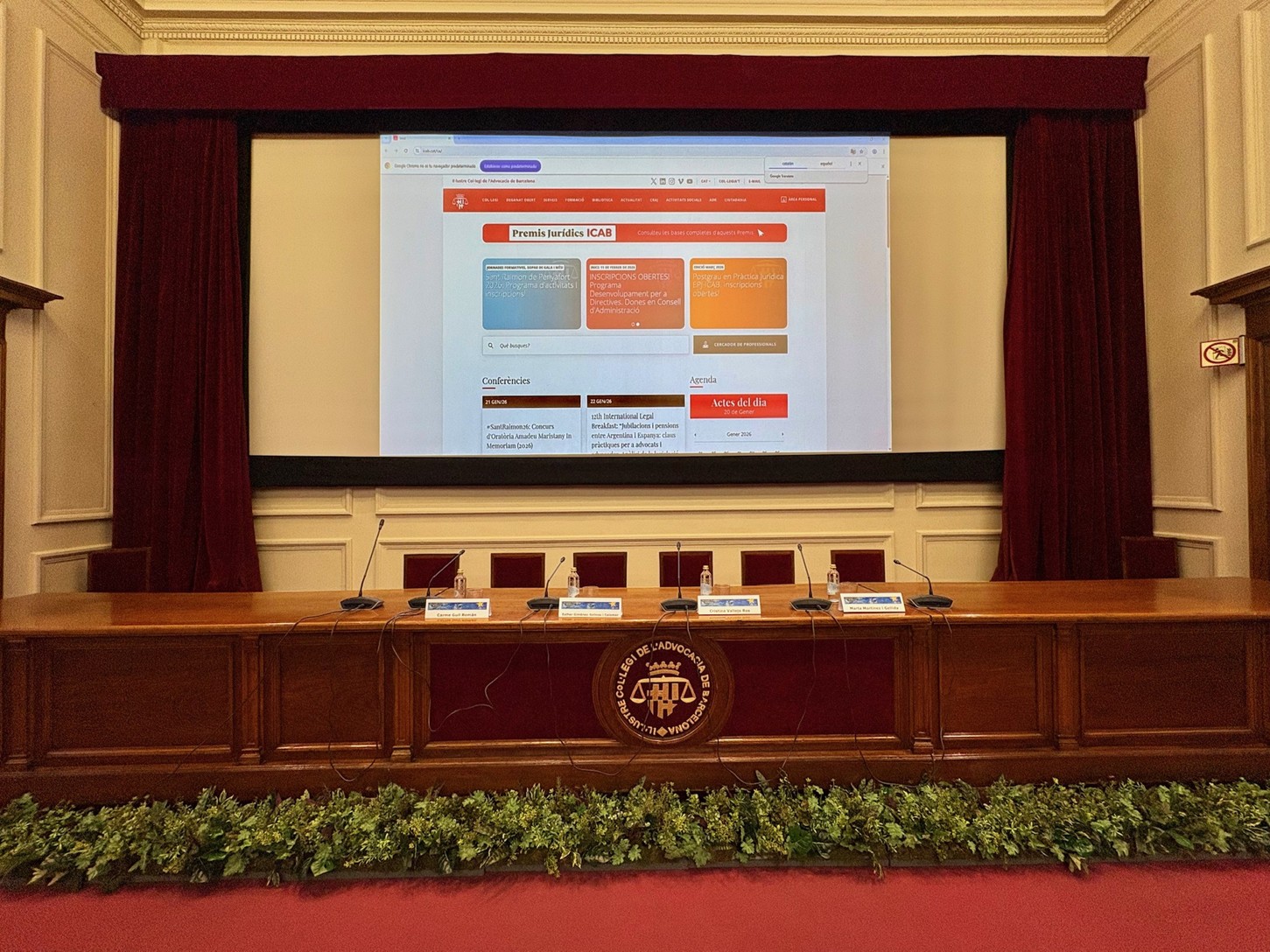
Within the framework of the commemorative activities of European Mediation Day, the European Mediation Day JEM 2026 held at the Barcelona Bar Association stands out especially, focused on the current challenges of mediation in light of the new scenarios derived from Organic Law 1/2025 and the progressive implementation of ADR (Appropriate Dispute Resolution Methods) in Spain. The session brought together professionals from the legal, academic and institutional fields and consolidated itself as a space for deep reflection on the present and future of the culture of dialogue and participatory justice.
During the conference, which I attended accompanied by my colleagues Jordi Vives i Carbonell, Bertram Müller and Enric Soriano, the importance of interdisciplinary work in the field of mediation was highlighted. Jordi Vives i Carbonell, mediator, commercial researcher and handwriting expert; Bertram Müller, mediator, biomechanic and educator; and Enric Soriano, lawyer, European reference in the field of systemic law, mediator and property manager, provide complementary professional profiles that reflect the richness and transversality that today characterizes ADR. The joint presence of professionals coming from mediation, the legal field, research, education, property management and expert analysis shows that dialogued conflict resolution is not an isolated field, but rather a space of collaboration between disciplines oriented toward a common objective: facilitating sustainable agreements and humanizing dispute-management processes.
Among the most notable interventions were those of Cristina Vallejo, Carles García Roqueta, Javier Wilhelm, David Bondia, Carme Panchón and Isabel Viola Demestre, whose contributions offered a plural, rigorous and deeply practical vision of the present and future of mediation.
Particularly significant was the intervention of Carme Panchón, who raised a reflection of great human and social depth: how can we measure the suffering of people immersed in judicial proceedings. Panchón stressed that mediation is the only ADR method that directly addresses the relationship between people and recalled that it is not about re-arguing the conflict, but about proposing a new scenario. She emphasized that the mediator’s function is not to decide or impose, but to organize dialogue, create a safe space without shouting, reproaches or threats and facilitate that the parties themselves find solutions. She also pointed out that mediation requires composure, professionalism and good faith, and that its promotion, even when the obligation of a prior attempt is established, aims to favor agreement and avoid subsequent conflicts that are more costly emotionally and judicially. In this sense, she highlighted that mediation is especially appropriate when the conflict is clearly relational.
Along the same lines, David Bondia, Ombudsman of Barcelona, emphasized the idea of facilitating solutions from the institutional sphere, explaining how the Ombudsman’s Office develops administrative mediations aimed at improving the relationship between citizens and administration through proposals that combine elements of mediation and conciliation.
For her part, Isabel Viola Demestre provided a particularly relevant legal and organizational perspective, highlighting the importance of quality control, the generation of statistics and the professionalization of mediation services. She also introduced the idea of conflict triage, inspired by health models and multi-door court systems, defending that each controversy must be referred to the most appropriate mechanism after prior analysis of its nature and relational context. Likewise, she stressed that the legal framework of mediation allows its application to all types of conflicts and that professional practice incorporates emotional and communicative dimensions that go beyond the regulatory text. She also highlighted the cultural evolution that is taking place both among citizens and in the academic and professional fields, evidenced by the increase in mediation requests, the incorporation of ADR into university curricula and the growth of professionals who double the number of cases managed through mediation. Finally, her analysis of the figure of the third expert or neutral evaluator showed that there is no universal formula to automatically assign dispute-resolution procedures, but that the suitability of each mechanism depends on the context, the real interests of the parties and the objectives pursued.
European Mediation Day: origin and meaning
European Mediation Day is celebrated every January 21 in commemoration of the approval, in 1998, of Recommendation R(98)1 of the Council of Europe on family mediation, a pioneering text that marked the beginning of the institutional recognition of mediation as an essential instrument for the peaceful management of conflicts. Since then, the Council of Europe and later the European Union have progressively deployed a more solid regulatory framework, promoting family, civil and commercial, criminal and restorative, administrative, school, community and intercultural mediation. January 21 is therefore a symbolic date that celebrates a different way of understanding justice: more humane, participatory, restorative and oriented toward coexistence.
What is mediation
Mediation is a self-compositive method of conflict resolution through which two or more parties, with the help of an impartial third party, attempt to reach consensual agreements by themselves that respond to their interests, needs and concerns. Unlike judicial proceedings, mediation places people at the center, promotes dialogue and communication, encourages shared responsibility in decision-making, seeks lasting and sustainable solutions and preserves personal, family, neighborhood or professional relationships. Mediation does not consist of deciding who is right, but of facilitating mutual understanding and helping the parties build their own solutions, transforming the conflict into a meeting space. From a legal point of view, mediation is a self-compositive conflict-resolution method, which means that the parties themselves construct and agree upon the solution with the support of an impartial third person who imposes no decision. By contrast, we speak of hetero-compositive methods when the solution is adopted by a third party with authority to decide, as occurs with a judge in a judicial process or an arbitrator in arbitration. The essential difference is that in self-compositive systems the decision arises from the will of the parties, whereas in hetero-compositive systems it comes from an external authority that resolves the conflict for them.
Why mediation is especially important today
We live in increasingly complex, diverse and interconnected societies where conflicts are no longer exceptions but a structural reality of social life. Courts are often overloaded, resolution times lengthen, emotional and economic costs increase and in many cases judgments do not resolve the underlying real conflict. Mediation makes it possible to offer faster, more flexible responses adjusted to the needs of the parties, contributing to the decongestion of courts. Family, neighborhood, educational and labor conflicts involve emotions, ongoing relationships and personal bonds that are difficult to address adequately through strictly legal resolutions. In this field, mediation, especially family and community mediation, is probably the most appropriate and effective tool. Furthermore, mediation strengthens individual responsibility, active participation, citizen empowerment and dialogued conflict resolution, contributing to the construction of more cohesive, mature and democratic societies.
Why Spain promotes ADR and mediation
In recent years, and especially with Organic Law 1/2025, Spain has made a firm commitment to promoting Appropriate Dispute Resolution Methods, among which mediation occupies a central place. This reform responds to various strategic objectives: modernizing justice, fostering intelligent de-judicialization, fulfilling European commitments and improving social coexistence. Especially in family and personal conflicts, mediation proves to be a particularly suitable tool, as it allows the preservation of bonds, the protection of minors, the reduction of emotional suffering and the construction of stable and lasting solutions.
A first quantitative indication of the impact of ADR in Spain
Recently, some data have begun to emerge that allow the first measurable effects of the application of Appropriate Dispute Resolution Methods to be observed. According to information disseminated from data of the General Council of the Judiciary, during the last quarter of 2025 the filing of new civil proceedings would have been reduced by more than 30 percent compared to the same period of the previous year. This decrease contrasts with the sustained growth trend recorded in previous quarters and is interpreted, from various institutional and professional spheres, as one of the first positive and quantifiable consequences of the entry into force of Organic Law 1/2025. The reduction in the entry of new litigation into the courts represents a relief of the judicial burden and points toward a progressive consolidation of a culture of dialogued conflict resolution, an evolution highly valued by entities and training projects linked to mediation and ADR.
Mediation and the European Union: a deep connection
Mediation is not only a legal tool but also a direct expression of the founding values of the European Union and its political, social and cultural project. Far from being a marginal option, mediation forms part of the core of the European model of justice, coexistence and social cohesion.
The mediation text continues with the same meaning as the Catalan version: European principles, Directive 2008/52/EC, the Italian case, cultural heritage, restorative justice and final conclusion, all maintaining the same structure and content.
Conclusion: a commitment of country and continent
Celebrating European Mediation Day is reaffirming a collective commitment to dialogue, social peace, shared responsibility and the culture of agreement. Mediation is not a minor alternative to justice, but a more advanced, mature and humane way of understanding it. The connection between Spanish regulations, European law and the founding principles of the European Union is not circumstantial but profound: mediation is a direct expression of the European project of coexistence, peace and social cohesion.
Daniel Sererols Villalón
Lawyer and Mediator
Barcelona, February 1, 2026