

10 Jan INTERVIEW WITH ALBERTO RAMOS CAZORLA
INTERVIEW WITH ALBERTO RAMOS CAZORLA
In memory of Darlin Menjady Canales Espinal
Word, neighbourhood and community future
Introduction by the AVV Plaça de la Farga
From the Association of Neighbours of Plaça de la Farga, we publish this interview with deep respect and with the intention of contributing to memory, reflection and community care after very serious events that have struck our neighbourhood.
In September 2025, Darlin Menjady Canales Espinal passed away, a minor and resident of Plaça de la Farga. His death, which is currently in the judicial investigation phase, has had a strong impact on his family and also on part of the neighbourhood. At particularly emotional times such as the Christmas holidays, pain and absence become even more present.
We believe that giving space to words, when done with respect, prudence and responsibility, is a way of dignifying pain and transforming it into collective reflection. This interview with his father, Alberto, is structured through written, open and unhurried questions, so that he may express himself freely, without pressure and with the degree of depth he himself decides.
Throughout the interview, there is discussion of the son, the family and grief, but also of the neighbourhood, the evening and night in Barcelona and in Sants-Montjuïc, the time of justice and the community future after such painful events. His words do not seek to point fingers or anticipate judicial conclusions, but rather to share experiences and reflections with respect and responsibility.
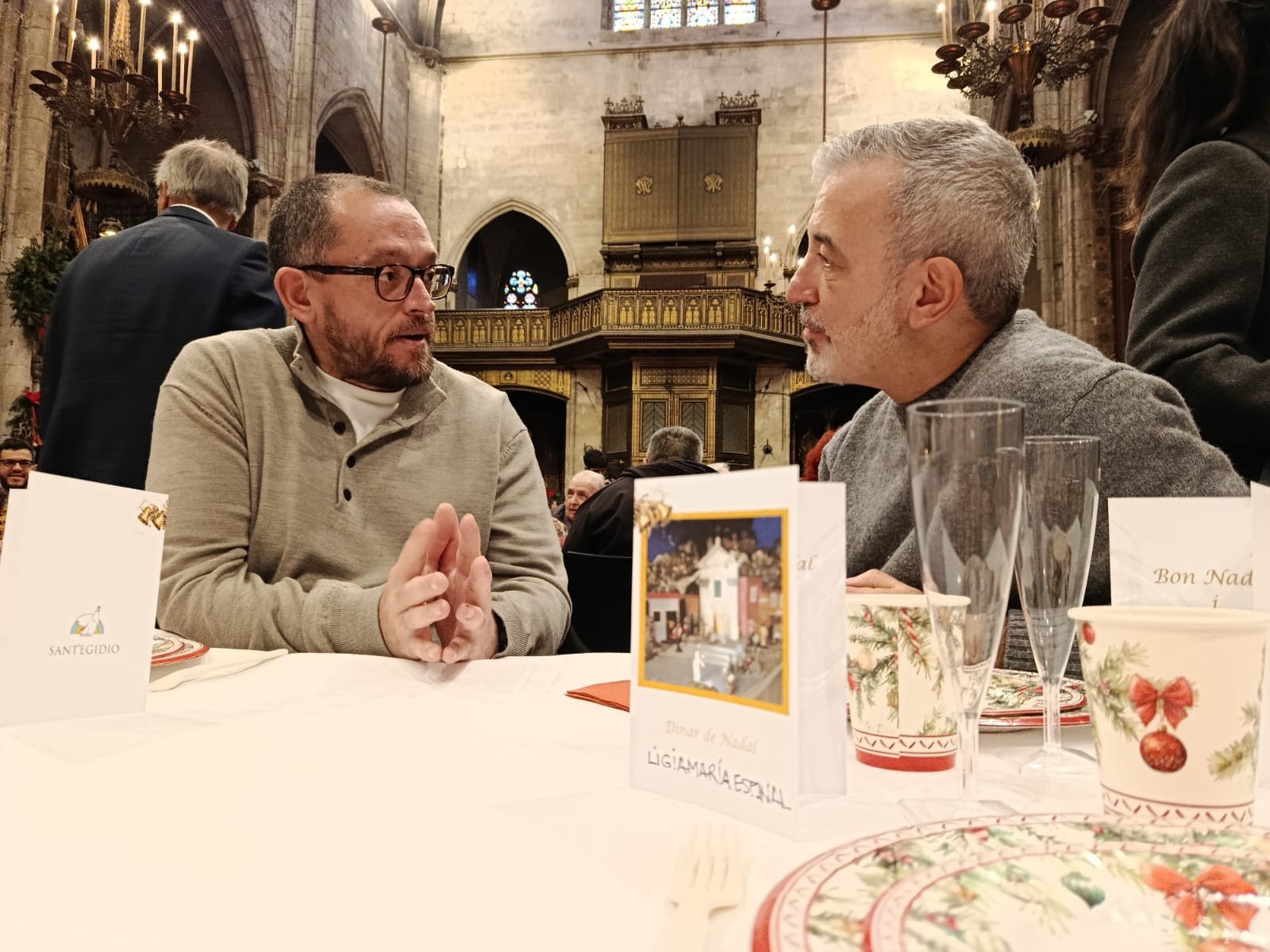
At the time of carrying out this interview, Alberto also participated in community dialogue spaces, such as the Sant’Egidio Christmas Day meal, where general conversations took place about coexistence and safety in the streets of Sants.
As a neighbourhood organisation, we publish this interview with a dual objective: to accompany a family in the memory of their son and to open a collective reflection on coexistence, safety and the care of public spaces. We do so with the conviction that neighbourhoods are also built by listening, caring for one another and assuming shared responsibilities.
Interview with Alberto, father of Darlin Menjady Canales Espinal
The son and memory
Who was Darlin to you, beyond being your son?
For me, Darlin, even though I was not his biological father, was a clear example of the kind of son one would like to have, always committed to his home and always helping everyone. From the very beginning, meeting him was a pleasant surprise for me; in a society so accustomed to adolescents being rebellious and believing themselves to be sufficiently grown up, he arrived with a seriousness, obedience to his mother and a maturity inappropriate for his age that left me astonished. For that reason, for me he was much more than my stepson: he was my support at home, the one I told my things to and he told me his, a friend, a confidant… in other words, much more than just my “stepson”.
If you had to define your son in three words, what would they be?
Mature, responsible and intelligent.
What memory of him comes to your mind most often these days?
Above all, when I pass by his room and see it empty… I always see him there, with his music and fixing his hair… making him laugh, which was so gratifying for me and everyone at home, because it was hard to get him to burst out laughing…
How would you like the neighbours of Plaça de la Farga to remember him?
Above all, as a good young man, who always expressed his happiness and enjoyment of living in this neighbourhood, which he compared to his village in Honduras. We were offered the opportunity to move away from here, and he himself made us stop the idea, because he felt this neighbourhood as if it were his lifelong neighbourhood.
The family and arrival in the neighbourhood
When you arrived to live in the neighbourhood last April, how did you feel as a family?
They (mother and son) arrived before me; because of work I was away and could only come on weekends, but we were always fascinated by the peace that is transmitted there, with all its shops and other conveniences so close, its park and good neighbourly atmosphere. Being from a small town myself, it reminded me more of that than of a neighbourhood in large Barcelona.
What would you highlight about the neighbourhood and its residents in those first months before the events?
As I said before, the peace, tranquillity and this small, well-kept green space that we have and appreciate, and the fact that we have all kinds of services and local businesses very close by, something that is already starting to disappear.
After what happened, is there any gesture, person or support from the neighbourhood that has stayed with you especially?
The truth is that this was my biggest surprise and, I’m sorry to say, the most disappointing. It seemed as though there was no news of what had happened; no one, until chance brought us into contact, showed concern about what occurred. It was as if nothing had happened here…
Grief and the time of justice
How does one live with such great pain when the events are still in the judicial investigation phase?
It is very hard to live with such a loss, of the only child you have, at 16 years old, adding to that knowing who did it and waiting for the trial to begin. It is something very difficult to carry inside; it destroys your head and your heart from within and greatly affects everyday life.
What is the hardest part of this time of waiting, of silences and unanswered questions?
Exactly that, the lack of answers, all the whys. Why take the life of a 16-year-old? What can justify that?
What gives you strength today to keep going, as a father and as a family?
My greatest motivation right now is my fight to achieve justice, justice not only for my son but for everyone. It is a hard battle, but it motivates me to continue with all my strength because events like this have no place in our society.
Beyond the final outcome, what do you expect from the judicial process?
I am a person who speaks plainly: I expect visibility for an alarming situation, where adolescents no older than 20 walk the streets armed and are capable of taking another person’s life with such coldness and then continue living in our neighbourhoods or nearby. For me, this is a sign that something is wrong.
How do you experience the passage of time when justice follows its rhythm, often slow?
It is desperate, honestly. Many days I am invaded by anger, hopelessness and the thought of why wait, why not apply an eye-for-an-eye type of justice… Other days depression arrives because of the waiting and the need to see him again… It is very, very complicated to live with all this; it is a roller-coaster life, as I say.
Evening and night in Barcelona and in Sants
You work in the field of security or night mediation. How do you see the evening and night in Barcelona today, from your experience?
The truth is that it personally worries me. I believe in the good work of the police forces, but sometimes it seems that problems multiply. Among the usual issues of drugs, pickpockets and other thefts, and without wanting to appear as something we are not, I see many foreigners who flee their countries because they already had problems there and here they take up that criminal life as if they were still there. I would also point out that the rise of mass tourism, sold the idea that here they can do whatever they want, creates a complicated situation, as many abuse alcohol or other substances, and then there are the vultures who take advantage of this with many burglaries of tourist apartments, thefts and scams… In short, sometimes, and as I say, in my humble opinion, it is worrying where we are heading as a society.
From your recent experience living in the neighbourhood, and also from your work, how do you perceive nights in Sants-Montjuïc today?
The truth is that night always brings out what is difficult to see and control. Here I would say that parks are a concern: many lack sufficient lighting, police control, video surveillance… I don’t know, at night I always see fights, robberies, episodes of gender violence, too many homeless people sleeping in the streets… The truth is that it changes a lot from day to night.
Do you think enough is being done through prevention, mediation and community work to avoid risky situations at night?
Yes, in my opinion I believe that things are being done through prevention, mediation and community work, but I also think that more could be done. Sometimes improvements are perceived in certain areas, although those improvements also end up generating secondary consequences that are not always taken into account.
From your professional and personal point of view, what would help most to improve night-time coexistence in neighbourhoods: more institutional presence, better lighting, more mediation, or a combination of all of this?
I support everything you mention and, above all, listening more to people in the neighbourhoods. I see a lot of fear among people to speak out and, faced with this forced silence, often due to supposed consequences and to the harm that invades our city, such as gangs and bad people that abound, everything continues as if nothing were happening.
How important do you think it is to listen to people who work at night on the street when designing public policies?
Very important!! As I say, working at night is hard and not without risk, so it will be those workers who can provide the most suggestions and ideas where they are most needed.
On Christmas Day, December 25, you participated in the Sant Egidi meal and were able to speak with the Mayor of Barcelona, Jaume Collboni, about the situation in the streets of Sants. From your professional experience and as a resident of the district, what concerns and messages do you consider important to convey to institutions when talking about coexistence and safety in public spaces?
Yes, taking advantage of Mr Collboni’s kindness and the fact that Mr Albert Batlle, head of security for the Barcelona City Council, was also present, we were able to talk with them about what I believe is necessary in the neighbourhood, such as more control of parks and, based on my experience, several hot spots in our neighbourhood. I think it went well; they were receptive and we agreed to continue addressing these issues outside of such significant days.
The neighbourhood, the future and the community
After what happened, what would you like to say to the neighbours of Plaça de la Farga and nearby neighbourhoods?
Something very clear and direct: today it was my stepson, but tomorrow it could be that of any other family in the neighbourhood. Either neighbourhoods and their people unite for common goods, or everything falls apart.
Do you think that as a community we can learn something from such painful events?
Yes, absolutely. As in everything in life, identifying the problem, reacting and seeking solutions must be fundamental.
When you think about the future of the neighbourhood, what would you like to change so that situations like this are not repeated?
Seeing more people involved. It is fine to unite for more global causes, but what about what happens here? What we are living now and here — what about that? Are we doing nothing?
How would you like the memory of Darlin Menjady Canales Espinal to contribute to building a safer and more humane community?
That it should not be said, as I have already had to hear, that all foreigners, immigrants and, in this case, Latinos are bad people. There is much to learn from one another and, united, we can try to leave our descendants something better than what we are leaving them now.
If you could address the young people of the neighbourhood directly, what would you tell them today?
That there are more options than it seems, that they may feel alone and misunderstood, and that what now seems to matter and have value are fashions, social networks and the opinions of others who are just as lost as they are — and that is not the case. Life is very short and their concerns need to be listened to more, and that is our task.
At such emotional times as Christmas, what does the memory of your son mean for you and your family?
Everything: not being able to celebrate these days with him… It is a very difficult feeling to reconcile — everyone wishing you happy holidays, the family spirit of Christmas, and seeing that your son is missing… At these ages we are already very familiar with remembering a deceased relative and the pain it causes, but a son? And at such a young age… what one feels is indescribable. It is such a great pain inside you that it takes a superhuman effort to live with it during these dates.
Reflections on justice and the Juvenile Law
In your case, the events are very serious and involve a minor. How do you experience, as a father, the way the system treats these cases when the Juvenile Law and serious crimes are involved?
This is a delicate issue. We are tired of seeing the Juvenile Law from the outside. Now that I have to deal with both courts, adult and juvenile, I am finding that, although I already had knowledge of the adult courts, the juvenile court was something I did not know and it surprised me negatively. For example, the time it takes to begin juvenile trials is longer than for adults, and I asked myself, why? My surprise comes from the large number of juvenile cases there are now; they are somewhat overloaded and take longer to issue verdicts that are then resolved in a very short time. In our case, we wait two years — which is the estimated duration of the trial — for it to then be resolved in one hour… It makes no sense to shield minors so much, even when, as in this case, they are involved in a homicide. As a trained psychologist, I see and understand the intention not to ruin a young person’s life, but I also do not see it as normal that these minors have no scruples about appearing happy on social networks, going out partying and laughing together while my son is in the cemetery. This juvenile law protects minors well, but in these situations, who protects the adults?
Do you think society understands well enough what the Juvenile Law implies and what its limits are in situations like this?
I think not. As I said, it is very different to see it on television or have it explained to you than to go to the juvenile court and see how it works from the inside. Perhaps, I think, if people who are already dissatisfied with the juvenile law saw how it really works, they would speak very badly of it.
From your personal experience, do you consider that there is a distance between the pain of families and the timelines or responses of the judicial system when minors are involved?
A great distance. In situations as traumatic as this, the homicide of an only child, the entire process should be faster. Two years with the anguish of whether they will pay for their actions or not is a terrible mental strain.
Do you think it would be necessary to open a social and community debate on how to better protect minors, but also victims, when such serious events occur?
Without a doubt. There is a great deal of work to be done with minors. I believe they do not fully understand what it means to have the coldness to take a person’s life, to live with that while that person is buried and their family is dead in life, undergoing psychological treatments of indefinite duration.
What would you say to those people in the neighbourhood who, faced with situations like this, feel helplessness or incomprehension regarding how justice works?
Very simply: anyone who feels this way cannot stay at home or express their disagreement quietly. They should ask the appropriate people who can suggest options on how to deal with all of this. Many times it is like daydreaming, but if we do not fight, we allow everything bad to happen. Just a few days ago, so to speak, I was the first to watch from the sidelines, and now, with what has happened, I had the choice either to give up and let everything be forgotten, or to start appearing everywhere to begin my fight against what is wrong in our current society. Of course, I am only an ant against the world, I know that… but can anyone imagine what thousands of ants working together could achieve?
Closing
What do you think we lack, as a society, to take better care of one another?
The most fundamental thing is unity. There is a great lack of empathy in these times, and although sometimes it is shown that unity makes strength, I miss that same level of involvement in problems closer to home. It is very good to see entire cities mobilise to protest against genocides and wars in the world, but we should also do so regarding the issues we live here, which in theory should be easier to address.
Often I do not see people reacting, and that is worrying. As I said before, this is also our war. That is why I try to initiate a struggle that is not only for my case, but for everyone, because this is not the image of Barcelona or Sants that I want projected outward. If this type of situation becomes normalised, what image are we giving of ourselves to the world?
Editorial conclusion of the AVV Plaça de la Farga
We deeply thank Alberto for his generosity and courage in sharing these words at such a painful time. Giving voice to suffering, memory and reflection is also a form of collective care.
From the neighbourhood, this interview challenges us as a community: regarding safety in public spaces, the role of prevention and mediation, the limits and tensions of the judicial system when minors are involved, and the need not to turn our backs on the pain of others.
As the Association of Neighbours of Plaça de la Farga, we reaffirm our commitment to coexistence based on dialogue, shared responsibility and the dignity of all people.
May the memory of Darlin Menjady Canales Espinal help us build a more attentive, safer and more humane neighbourhood.
Daniel Sererols Villalón, January 10, 2026
President of the Association of Neighbours of Plaça de la Farga (Neighbourhood Federation), lawyer and conflict mediator registered with the Ministry of Justice, the Barcelona Bar Association, the Catalonia Mediation Centre and the Association of Mediation Professionals of Catalonia (ACDMA).